

Key AI Development Trends Businesses Will Need to Watch in 2026
Artificial Intelligence | By Josh Mark | 24-08-2026
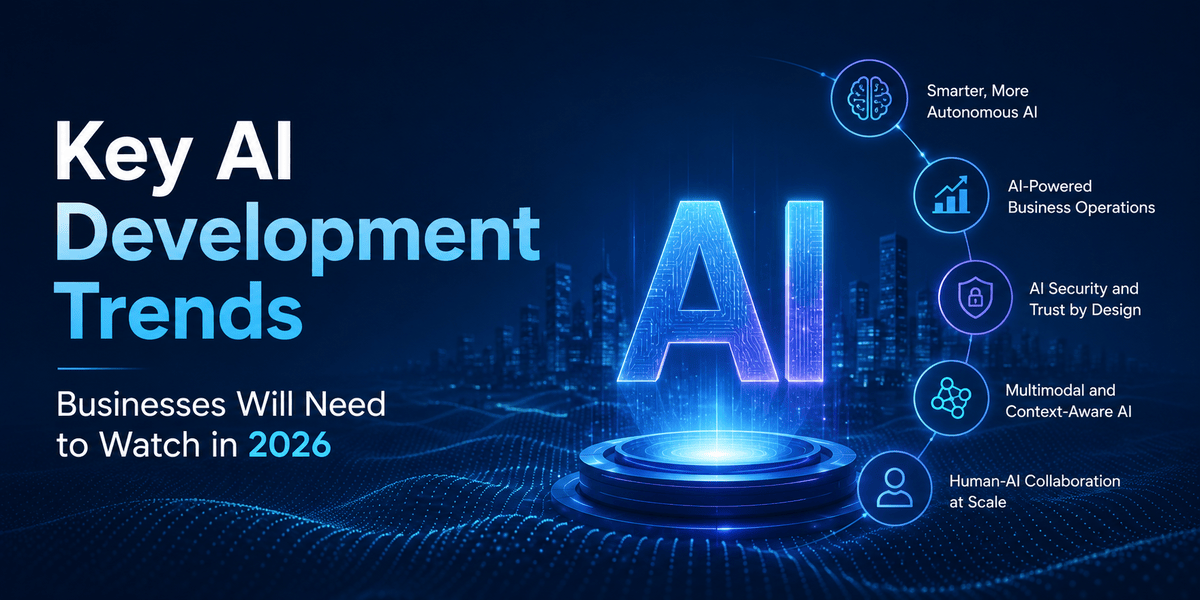
Currently, AI startups come up with new tools on a daily basis. Businesses that ignore them fall behind fast. This year is not about small updates. Some of these changes affect how software gets built. Others change what businesses expect from AI development services once the tool is actually live.
Only recently have businesses begun using AI at all. Now, AI is integrated across nearly every part of every business, from support to finance to warehousing, sales, and marketing. It’s not just possible, it’s efficient and cost-effective. Running legacy AI means running an uncompetitive business. A chatbot that is cumbersome and slow in 2026 will actually place your business in the past, not the future.
Here is the list of some trends to watch now. You will not find any sensationalism here, just the facts and why these trends are worth knowing.
AI That Works, Not Just Talks
AI used to answer questions. That was it. Now it finishes whole tasks without anyone watching each step.
Picture a system that books a meeting, checks three calendars, and sends out the invite on its own. No human clicks through any of it. That is the shift.
Support teams are already using this. A helper no longer just replies to a question. It looks up the order, checks the return policy, and processes the refund, start to finish.
Teams building this kind of AI have to think differently. The code needs to handle mistakes and weird edge cases, because the AI is making choices now, not just talking back.
Here is the catch. These tools need heavy testing before they go live. A small mistake costs more when the AI is taking action instead of just offering advice.
Say a warehouse tool reorders stock automatically once it runs low. Simple enough. But what happens when a supplier raises prices overnight? Or a product gets pulled off the shelf? You need to have rules for the edge cases from the beginning. Patches come later.
Most companies doing this in 2026 start with low volumes. One task. One workflow. Tested well before adding the next one. Slower, yes, but it beats a fast rollout that loses customer trust in week one.
Smaller and Specific AI Tools Are Especially Useful
Bigger AI tools charge more, take longer to respond, and have a lot more breakable components.
Anything can break if the wrong parameters are used, and, of course, the larger the tool, the more there is to break. It is possible to make something better that does less and more efficiently so that it includes fewer breakable parts. So more businesses in 2026 are picking smaller tools built for exactly one job. One that only sorts support tickets. Another that only reads bills. Nothing fancy, just fast and cheap.
Why does this matter for AI development services? Because building something small and focused takes real skill. It is not the same as plugging into a big general AI and calling the job done. A good AI development company knows how to size the tool to the task, not just reach for the biggest option on the shelf.
Cost drives most of this. Running a huge tool for a small job is like sending a truck to deliver one letter. It gets there, but you wasted fuel and time getting it there.
Speed is the other piece. A focused tool often answers in under a second. A big general one can take much longer once a lot of people are using it at the same time. A business fielding thousands of chats a day feels that gap fast.
There is a real trade-off here, worth being honest about. Small tools struggle with broad, open-ended questions. They shine at narrow, repeat tasks. So a lot of businesses run a mix now, a small tool for everyday work and a bigger one saved for the harder cases. Getting that mix right is where an experienced team earns its fee.
AI Development Services Are Shifting Toward Custom Builds
Ready-made AI tools were fine when the job was simple. Businesses want more now. They want tools that actually understand their own customers and their own way of doing things, not a generic script pretending to.
That is pushing AI development services toward custom builds. Businesses request custom chatbots. These are chatbots that are trained by the businesses’ data as well as their past support tickets and product information. The answers land differently because of it.
Custom AI development takes longer up front, sure. It pays off later. A tool trained on your own data gets more answers right, and fewer wrong ones. That builds trust instead of eroding it one bad reply at a time.
Businesses hiring a team now ask harder questions before signing anything. What data trains the tool? Where does that data get stored? Who owns the finished product once it ships? Two years ago, almost nobody asked these. Now it is routine.
A custom tool also grows with the business. A generic chatbot stays frozen no matter what changes inside the company. A custom one updates as products change, as policies shift, as customer needs move. That flexibility is worth the extra weeks it takes to build.
Smaller businesses used to assume custom AI was out of their price range. Less true now. Better starting models and cheaper cloud costs mean a mid-size company can afford a custom tool that once needed an enterprise-sized budget.
More Care Around AI Safety and Fair Use
Rules around AI are catching up fast. The US, UK, and EU have all added new requirements this year. This will undoubtedly affect the approach to the development of AI for the foreseeable future. Safety checks used to happen right before launch, as a last step. Now they run through the whole build. Teams test for unfair outcomes early. They record each step of how the AI comes to a decision. If a regulator, or a customer, comes to them asking for a reason behind a specific decision, they have built something that provides an explanation.
Skip this and the risk is real. An AI development company that treats safety as an afterthought will run into trouble down the line. Fines are only part of it. A business's reputation takes the harder hit when an AI tool makes an unfair call in public.
Ask any AI partner how they test for safety before hiring them. Good records matter more than most businesses realize until they need them. A paper trail is necessary to defend an unfair decision made by an AI. In the absence of a paper trail, there is no reasonable way to defend the decision. Building that trail from day one saves real trouble down the road.
Some businesses now check their AI tools every few months to make sure results stay fair over time. Rare a few years back. Close to standard now, at least for anyone using AI somewhere sensitive like hiring or lending.
Voice and Picture-Based AI Tools Are Growing
Typing is no longer the only way people talk to AI.
More apps now handle spoken words, pictures, and typed text all together. The AI image analyzer can identify problems, and with the addition of AI-powered text formulation with natural language, an explanation can be generated in simple text.
Building this well is real work. The system has to process pictures, sound, and text at the same time, then pull it all into one answer that actually makes sense. Harder than a plain text chatbot, no question. But for businesses in retail or repair work, it makes the tool genuinely more useful, not just flashier.
Voice ordering. Photo-based search. Hands-free support. All of it is growing fastest in businesses with a physical footprint, think warehouses, stores, repair shops.
Restaurants are a clean example. A customer can speak their order instead of tapping through a tiny screen. The AI catches swaps, flags allergies, confirms special requests, and reads it all back before anything gets sent to the kitchen. Fewer mistakes, faster line.
Retail is moving the same direction. A shopper photographs a jacket and asks if it comes in another color, no digging through filters or menus required. Small stuff, but it adds up in how a customer remembers a brand.
How Businesses Pick an AI Development Company
Price and portfolio used to decide it. Not anymore.
Data safety comes first now. Where is training data stored? Who has access to it? Does it get reused to train some other client's model too? These questions decide whether the contract gets signed.
Support after launch counts for a lot as well. AI tools need updates as information shifts and new risks show up. A team that vanishes right after launch leaves a business stranded the first time something breaks.
Fitting into existing systems is another deciding factor. Most businesses already run other software, customer databases, inventory systems, payment tools. An AI development company that cannot connect its tool to any of that just creates more manual work, not less.
Here is what businesses are prioritizing when picking a partner:
- Straight answers about who owns the data and how it stays private
- Support that goes beyond launch day
- Real experience connecting AI tools into systems already in use
- Honesty about what the AI can and cannot actually do
That last one matters more than people expect. It shows how a team handles delays or bugs after launch, because every AI project hits a bump eventually. What separates a good partner is how they respond when it happens.
Pricing structure is worth a close look too. Some teams charge one flat fee. Others bill based on usage once the tool goes live. Neither is automatically the better deal, but know which one you are agreeing to before the first invoice shows up, not after.
The Cost of AI Development Is Reducing
Building AI used to demand a huge budget. Not always true anymore.
Free, shared AI models have gotten a lot stronger. Businesses can now start from a solid base instead of building everything from zero, which saves real time and real money.
Cloud-based AI tools got cheaper too. Running and training no longer needs the massive upfront spend on equipment it once did. A small business can afford tools today that were simply out of reach three years ago.
None of this makes AI development free or effortless. Skilled teams still cost money. Custom work still takes time. But the entry price has dropped enough that businesses far smaller than the big players are shipping real AI tools in 2026.
Payment plans have shifted too. More teams now offer phased pricing, a small working version first, then expansion once it proves itself. That lowers the risk for a business trying AI for the first time. Fewer six-figure bets made before anyone knows if the thing actually works.
Final Take
AI development in 2026 comes down to action, focus, and trust. Tools that do real work on their own. Smaller tools built for one job well. Custom builds trained on real business data. Safety checks aren't afterthoughts in the design process.
There's no need to totally redesign all at once. One workflow should be your starting point for tackling an issue you are facing. Go for the change that impacts you positively over the change that appears to be the most impactful in your pitch deck. The businesses that are getting it right this year with AI are not playing the feature catch up game. They are taking a measured approach, frequent testing, and squad partner selection that is honest about their offered services.

Josh Mark
| AuthorThis blog is published by Josh Mark
Recent Blogs
.jpg "Benefits of Order Tracking Apps for E-Commerce")
Benefits of Order Tracking Apps for E-Commerce
Mobile Apps | 24-09-2026
.jpg "10 Ways Salesforce SMS Improves Customer Engagement")
10 Ways Salesforce SMS Improves Customer Engagement
Salesforce | 23-09-2026
.jpg "How Full Stack Development Supports Scalable Enterprise Apps")
How Full Stack Development Supports Scalable Enterprise Apps
Mobile Apps | 22-09-2026
.jpg "Seedance 2.5 vs Higgsfield for App Launch Videos")
Seedance 2.5 vs Higgsfield for App Launch Videos
Technology | 14-09-2026