

How AI is Transforming the Future of Work and Automation
Artificial Intelligence | By Jaisiva | 04-11-2025
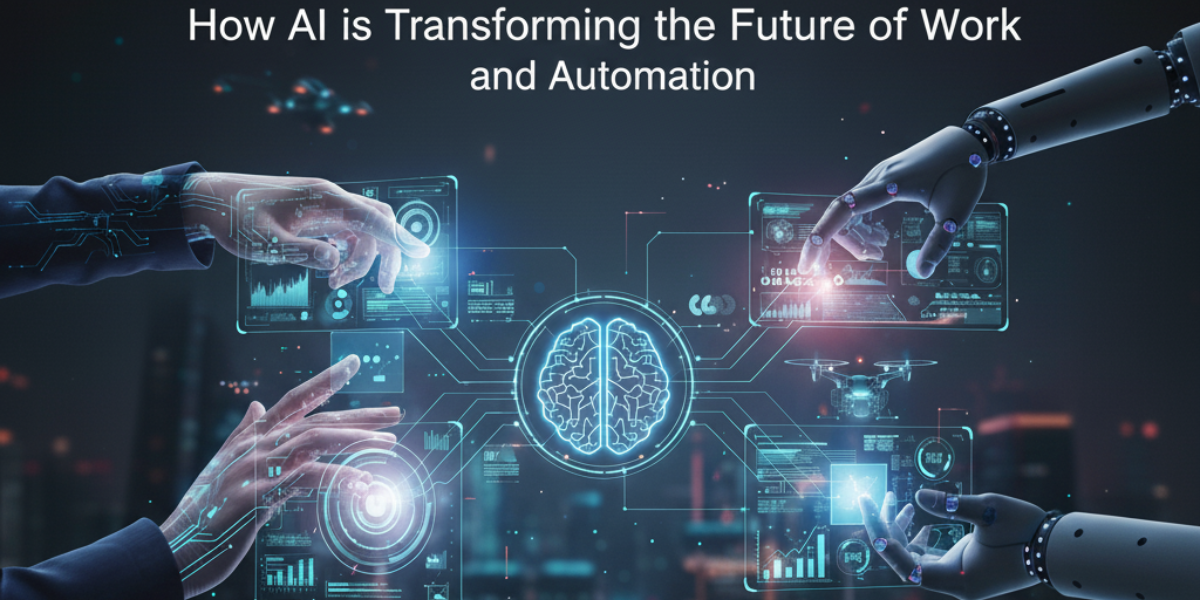
Artificial Intelligence (AI) is no longer a far-off notion from science fiction; it has integrated itself closely into how we live, work, and collaborate. From tailored suggestions on streaming services to smart analytics in companies, AI is effectively ingrained into our everyday personal and professional lives.
In the professional space, AI is transforming how people interact with technology and one another. It is enabling companies to automate tedious tasks, improve efficiency processes, and make better decisions based on data. More importantly, AI is redefining what work looks like—the opportunity for people to be creative, innovative, or work more effectively with artificial intelligence or machines.
In this article, we will look at how AI is shaping the future of work and automation, the opportunities and challenges it provides, and how businesses and employees can prepare for this new dawn of intelligent automation, increasing our chances to capitalize on a fast-changing environment.
Examples and types of AI and automation.
AI and automation in the workplace refer to software or machines that can do tasks that previously required human intelligence, such as decision-making, reasoning, problem-solving, learning, and perception. AI allows systems to adapt to data, improve over time, and complete cognitive tasks with high speed and precision.
Automation, in contrast, is when technology is deployed to carry out repetitive, rule-based tasks with minimal human involvement. Automation is considered intelligent automation when AI is employed to power it—the technology can learn from data and improve upon its performance over time.
AI and automation together are heralding the next industrial revolution. From chatbots that are available 24/7 for customer inquiries to predictive analytics tools that drive business decision-making, AI-enabled automation is infusing smarter, faster, and more efficient workflows across industries, including logistics, healthcare, manufacturing, finance, and retail.
If you’re interested in learning how AI is evolving in business environments, check out top generative AI companies in Bangalore that are leading innovation in automation and AI-driven solutions.
Real-world examples include:
- AI-powered chatbots providing fully automated customer support.
- Predictive analytics predict trends and optimize advertising campaigns.
- Robotic process automation (RPA) is automating its human counterpart in the back office.
- Machine learning detects fraud and highlights anomalies in financial transactions.
- Natural Language Processing (NLP) quantifies customer sentiment and feedback.
AI does not simply change how we work—it is changing what we mean when we say "work." Intelligent systems are creating entirely new categories of work, increasing productivity and operational efficiency and unmatched levels of innovation.
The Value of AI and Automation
AI is changing work not only for convenience but also to ensure competitive viability. Businesses that are adopting AI are finding themselves nimbler, more productive, and able to adapt to changes in today's turbulent economy.
Here is why the transformation is important:
- Increased Productivity: AI automates all manner of time-draining, repetitive tasks, allowing employees to focus on higher-level, more creative, strategic work.
- Smarter Decisions: Machine learning models can process millions of data points in seconds, bringing insights to the table that would be impossible for humans to find.
- Personalization: AI will personalize experiences for customers, employees, or both. Enabling them to interact in a more personalized, engaging manner.
- Transformational Job Roles: While some traditional jobs are being automated, many new jobs created in AI development, data science, or AI ethics will be taking their place.
- Competitive Edge: Businesses that adopt AI sooner than others will have strategic advantages in planning, innovating, or reacting to changing market conditions.
Significant Ways AI is changing work and automation.
Let’s take a look at some of the primary ways that AI is changing work and automation.
1. Task Automation and Efficiency
One of the more visible effects of AI is the automation of repetitive and mundane tasks. Functions such as data entry, processing invoices, making appointments, and generating reports are things that can occur automatically with little or no human involvement.
This task automation not only saves time and resources but also minimizes errors and operation costs. Employees can now focus their efforts on the more human-centric tasks that involve creative thinking, innovation, and problem-solving.
For example, in customer service, AI chatbots are now doing the initial interaction, allowing human customer service representatives to spend their time with customers whose problems require human cognitive skills such as empathy and critical thinking. In finance, AI has the ability to automatically reconcile documents and records, allowing finance staff to save time on laborious manual accounting activities.
Thus, a more productive and engaged workforce with employees spending their time on more interesting and intellectually stimulating work that relies on human judgment and creativity.
2. Decision-Making Based on Data
Data is also now referred to as the "new oil," and AI is what has allowed for organizations to refine data. Through the advanced analytics, organizations are able to pull insights from huge volumes of structured and unstructured data.
AI models are capable of predicting demand, forecasting sales, detecting fraud, and optimizing supply chains. It allows (and increases) businesses to make decisions that have the advantages of being not just faster but also accurate and evidence-based.
As an example:
- In retail, AI is used to predict consumer buying behavior and adjust inventory accordingly.
- In finance, it can analyze market data and provide guidance regarding investment strategies.
- In healthcare, AI can help doctors identify diseases early and suggest personalized treatments.
To summarize: AI enables predictive and prescriptive decision-making and replaces “guesstimating” with human intelligence.
3. Personalized Workflows and Digital Assistants
One of the more human-friendly things that AI brings is personalization. Current AI tools such as Microsoft Copilot, ChatGPT, and Google Gemini can be customized to individual work habits and assist with daily work-related tasks.
These digital assistants can:
- Draft emails, reports, and proposals.
- Summarize long documents or meeting transcriptions.
- Suggest creative ideas or brainstorming for inputs.
- Schedule and navigate meeting workflows.
By personalizing the work experience based on individual preferences, productivity is enhanced while reducing stress and increasing engagement.
To explore how AI technologies evolve across industries, see how generative AI solutions are reshaping business processes and creativity worldwide.
4. Human-AI Collaboration
The future of work is not humans vs. AI, contrary to what is often feared. Intelligent systems will become incredibly effective collaborators that enhance human capabilities rather than replacing them.
For example, designers implement AI tools for creative concepts, marketers utilize AI analytics for targeting audiences, and engineers deploy AI simulations for product improvements.
In this symbiotic environment, humans add creativity, ethics, and emotional intelligence as AI provides speed, scale, and accuracy. Together, they provide a unique level of problem-solving.
5. New Roles and Skills
As AI automates traditional jobs, it also generates new career opportunities. Job roles such as AI trainers, data scientists, machine learning engineers, AI ethicists, and automation strategists are seeing considerable demand.
Moreover, jobs are simply being redefined. For example, marketers need data analysis in addition to their other skills; human resource professionals use AI for attracting talent, and project managers rely on AI to automate workflows.
The workforce of the future will need to develop continuous education skills and digital literacy to remain relevant to the labor market impacted by AI.
6. Enhancing Business Processes
AI is making end-to-end processes more intelligent and interconnected. In supply chain management, AI assists with logistics routes and waste reduction. In human resources, AI performs recruitment screening so that the right talent can be selected in an efficient manner.
Departmental functions such as marketing, sales, finance, and operations already operated in silos until they ultimately began to connect through AI platforms that would analyze real-time data, predict future performance, and even offer recommendations based on the best action to take.
This overall connectivity reduces communication breakdowns, improves coordination, and ensures efficiency throughout the organization.
Benefits of Adopting AI and Automation
Organizations that implement AI into their business processes and workflows have a number of tangible benefits:
- Increased Productivity: Allowing technology to handle repetitive processes leads to completing tasks in less time and freeing the employee to spend their time innovating.
- Greater Accuracy: Machine learning can greatly reduce the number of errors attributable to humans, for uniformity in results.
- Cost Savings: Reduced labour results in decreasing operational costs and therefore a greater ROI.
- Improved Customer Experience: Technology, particularly chatbots and recommendation systems, can personalize engagement with customers in real-time.
- Innovation and Creativity: Beyond administrative tasks, utilizing AI saves significant Mindspace for the human to think creatively and strategize for the organization.
- Scalability: One of the biggest advantages of AI is that organizations can scale without necessarily adding to their workforce.
- Around-the-clock Availability: AI never sleeps, which means customer support does not either.
Challenges of AI in the Workplace
Though AI will offer large improvements, rational considerations that address these inherent challenges will need a considered approach:
1. Job Displacement Concerns
Automation will happen when these jobs reduce the requirement for manual or repetitive jobs. That increase concerns for lack of jobs. However, historically, technology revolutions create more jobs than they eliminate, just in different sectors. The exceptions to that are in reskilling employees and meeting the future role requirements.
2. Skills Gaps
The demand for skills in AI, data science, and digital skills is growing faster than the supply. It is vital that there are continuous upskilling opportunities and partnerships between businesses and educational institutions.
3. Data Privacy and Ethics
AI systems are primarily dependent on data. It is important that data collection, storage, and usage are all undertaken ethically. Things such as surveillance, consent, and data bias must be managed to be trusted.
4. Implementation Costs
For small and medium-sized enterprises (SMEs), the implementation of AI may be a fiscal strain. However, administration of AI use is becoming easier and cheaper through the adoption of cloud-based AI systems and tools available on subscription.
5. Algorithmic Bias and Fairness
Any AI system may inherit biases in the data that is used to train those systems or in models that exhibit bias. This can lead to unfair or discriminatory outcomes. In order to mitigate these risks, organizations should consider ethical AI design, transparency measures, and regular audits.
How Companies Can Embrace AI Changes
Integration of AI is not just a tech upgrade; it is a strategic shift. Companies will need to rethink their culture, abilities, and processes to realize AI’s full potential.
1. Go Slow; Start Small, Then Scale
Start using AI in targeted areas of the business (such as marketing or customer service) and test the use cases before scaling the process across the organization.
2. Train Employees to Use AI
Training employees on digital literacy, use of artificial intelligence tools, and analytical thinking skills will smooth the process, allowing the workforce to be more confident and capable in executing their jobs and tasks.
3. Focus on Ethical AI
Responsible use of AI requires commitment to transparency, fairness, and accountability. Achieving this will build trust with employees and customers alike.
4. Encourage Humans and AI to Work Together
Research shows that we benefit from human-AI collaboration. Establish a culture that views AI like a coworker that is there to help employees—not replace them. Set up scenarios to facilitate humans and machines working together.
5. Rethink Leadership
Key leaders should begin to adopt AI for decision-making and operational management, experimentation, and innovation while maintaining empathy and oversight for ethical practice.
The future is humans and AI.
AI will continue to progress, most likely as an enhancement to human intelligent work and knowledge. The concept of an AI co-pilot will likely become commonplace, for instance, assisting employees in real-time, making smart analytical predictions to drive company decisions, and using robots to perform labour-intensive work.
AI will facilitate remote work, flexible schedules, and hybrid collaboration strategies, which mitigate employee stress and bolster employee well-being and work-life balance.
The future of work will revolve around co-intelligence: humans and machines working together seamlessly, where human creativity is combined with machine intelligence to improve productivity.
Conclusion
AI is already changing how we communicate, create, and provide value at work. While automating repetitive tasks, it presents a whole new world of possibilities for growth, innovation, and human collaboration.
The challenge for organizations today will not be whether AI changes the way they work, but how quickly they adapt to stay ahead.
Those who win in the AI-driven future will be the ones that know how to integrate human intelligence with artificial intelligence—combining empathy, creativity, and ethics with the power of automation.

Jaisiva
| AuthorThis blog is published by Jaisiva.
Recent Blogs
.jpg "Benefits of Order Tracking Apps for E-Commerce")
Benefits of Order Tracking Apps for E-Commerce
Mobile Apps | 24-09-2026
.jpg "10 Ways Salesforce SMS Improves Customer Engagement")
10 Ways Salesforce SMS Improves Customer Engagement
Salesforce | 23-09-2026
.jpg "How Full Stack Development Supports Scalable Enterprise Apps")
How Full Stack Development Supports Scalable Enterprise Apps
Mobile Apps | 22-09-2026
.jpg "Seedance 2.5 vs Higgsfield for App Launch Videos")
Seedance 2.5 vs Higgsfield for App Launch Videos
Technology | 14-09-2026