

How Are AI and Machine Learning Changing Mobile App Development in 2026?
Artificial Intelligence | By Albert Hilton | 06-07-2026
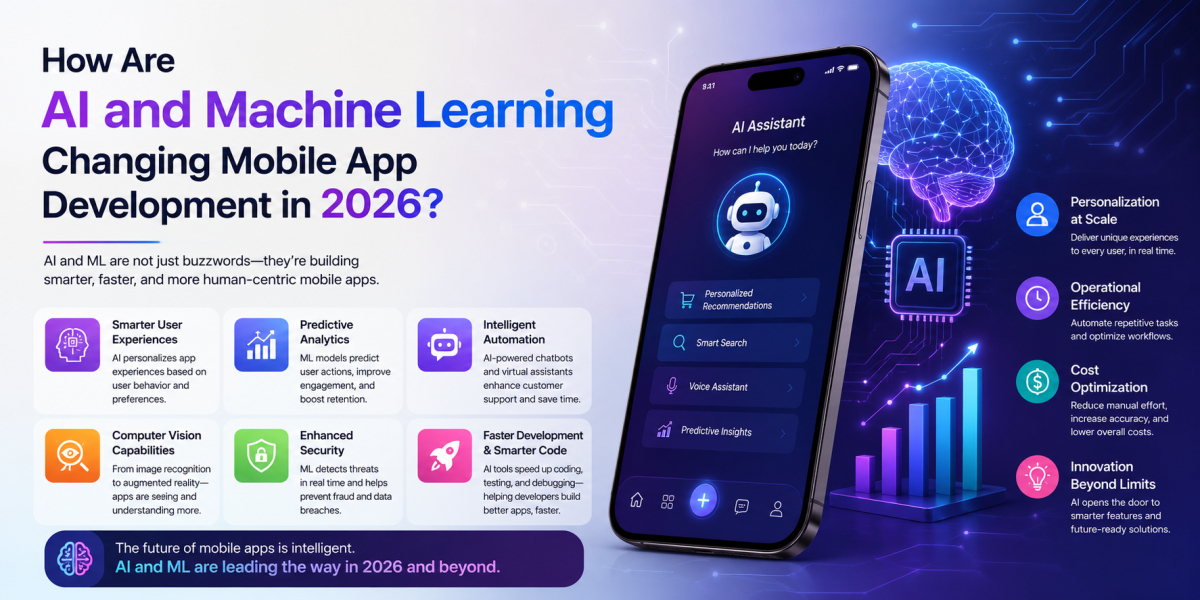
In almost any popular mobile app in 2026, you'll find AI working quietly in the background. Whether it's a shopping app recommending products you'll likely buy, a fitness app adjusting workout plans based on your progress, or a banking app detecting suspicious transactions. This particular shift isn't happening by accident. Companies are under constant pressure to deliver better UX, release products faster, and make smarter decisions using data. AI and machine learning help them do exactly that.
According to Wikipedia, machine learning systems can learn patterns from data and improve performance without being explicitly programmed for every task. This capability is changing how mobile applications are designed, developed, tested, and maintained.
Today, AI and Machine Learning in mobile app development are no longer reserved for large technology companies. Startups, mid-sized businesses, and enterprises are integrating intelligent features into their apps to stay competitive.
The Role of ML and AI in Mobile App Development
Mobile applications have changed far beyond their original purpose. A decade ago, applications primarily served as digital tools for performing particular tasks. Today, they can predict user behavior, adapt experiences, and automate decisions in real time.
The fast development of mobile data is another factor that leads to this shift. Every transaction produces useful data that can be studied and turned into meaningful insights. Artificial Intelligence systems use this data to discover trends that cannot be spotted by humans alone.
The recent industry reports show that the global AI market continues to increase at a significant pace, making a new opportunities for businesses across finance, healthcare, retail, entertainment, and education. As a result, AI is moving from being a feature to becoming a core component of modern app architecture.
Many organizations now work with an AI development company to identify opportunities to improve user engagement, automate workflows, and create more personalized digital experiences.
Why AI Is Becoming Essential for Modern Mobile Apps
User expectations have changed considerably. Nowadays, users expect applications to not only predict their preferences but also provide instant assistance and information without having to engage frequently. Rule-based systems fail to meet user expectations.
The role of AI in filling the void created between these expectations and current application capabilities is evident.
For instances,
- Apps for shopping recommend items in line with previous purchases.
- The routing/navigation applications suggest the optimized route depending on the traffic.
- The video streaming applications make recommendations based on viewing habits.
- The finance-based applications analyze the expenses and suggest a budget plan.
- Routing and navigation apps suggest optimized paths depending on traffic conditions.
And in most cases, users do not even know that artificial intelligence is driving these apps.
Key Technologies Powering AI-Driven Mobile Development
|
Technology |
Primary Function |
Common Mobile App Use Cases |
|
Machine Learning (ML) |
Learns from data to identify patterns and make predictions |
Product recommendations, user behavior analysis, predictive analytics |
|
Natural Language Processing (NLP) |
Understands, interprets, and processes human language |
Chatbots, virtual assistants, voice search, and customer support automation |
|
Computer Vision |
Analyzes and interprets images and video content |
Facial recognition, document scanning, visual search, and augmented reality (AR) features |
|
Deep Learning |
Uses multi-layered neural networks to solve complex tasks with high accuracy |
Speech recognition, image classification, language translation, fraud detection |
Several technologies cooperate in creating intelligent mobile applications. All of them have a particular function in terms of enabling the learning, automation, and personalization of apps.
Machine Learning
ML is the basis of most AI-based mobile applications. Machine learning algorithms process large volumes of both past and current data to establish certain patterns and predict future behaviors. For instance, an app for online shopping can predict what the user will purchase based on previous purchases, while a mobile application designed for fitness purposes may suggest customized exercises based on the user's activity.
Natural Language Processing (NLP)
With natural language processing (NLP), mobile applications can comprehend, analyze, and produce human language. Some examples include virtual assistants, chatbots, speech recognition, and customer service bots. NLP enables applications to detect user intent, communicate effectively, and give appropriate responses. With the advent of more sophisticated language processing models, users can communicate with applications using natural language.
Computer Vision
Computer vision allows apps on mobile devices to comprehend information obtained from images and videos through the use of AI models. Computer vision allows apps to perform tasks like object recognition, facial recognition, document scanning, defect detection, and augmented reality. Sectors that are currently making use of computer vision include the healthcare sector, the retail sector, and the security industry. For example, online shopping apps can enable users to search for products using photos.
Deep Learning
Deep learning refers to an advanced type of machine learning algorithm based on neural networks. This methodology is highly effective in dealing with challenges such as speech recognition, image classification, natural language processing, and prediction. The benefits of deep learning models are that they are able to establish connections within a dataset that conventional methods might overlook. Many of today's most advanced AI features, including voice assistants and real-time image recognition tools, rely heavily on deep learning technologies.
Together, these technologies are driving some of the most significant AI mobile app trends in 2026, helping businesses build smarter, faster, and more adaptive mobile applications.
How AI and ML Are Transforming Mobile App Development
The impact of AI extends across nearly every stage of the development lifecycle.
AI-Powered Code Generation and Development Automation
Development teams are increasingly using AI tools to accelerate coding tasks. Modern coding assistants can generate boilerplate code, suggest improvements, identify bugs, and automate repetitive programming work. This lets developers spend more time solving business problems instead of handling routine tasks. As a result, project timelines become shorter, and development costs can be reduced.
Personalized User Experiences Through Machine Learning
Personalization remains one of the strongest applications of machine learning. Rather than presenting similar content to every user, intelligent systems customize experiences based on behavior, preferences, location, and usage patterns.
This creates a more engaging experience and often leads to higher retention rates.
Businesses investing in AI chatbot development are also using personalization techniques to deliver conversations that feel more relevant and helpful to individual users.
Predictive Analytics for Smarter Decision-Making
Predictive analytics helps applications anticipate future actions based on past data.
Some of the examples include:
- Predicting customer churn
- Forecasting product demand
- Identifying purchasing behavior
- Estimating delivery times
- Detecting potential system failures
Such capabilities help businesses make better decisions and respond proactively instead of reactively.
AI-Driven Testing and Quality Assurance
Testing is one of the most time-consuming phases of software development.
AI-powered testing tools can automatically identify defects, prioritize test cases, and predict areas where failures are likely to occur. This improves software quality while reducing manual effort.
Enhanced App Security and Fraud Detection
Security threats continue to evolve, especially in healthcare and financial applications. Machine learning models can analyze behavioral patterns and detect weird activities that may indicate fraud or unauthorized access. For instance, a banking app may recognize that a login attempt changes significantly from a user's usual behavior and trigger additional verification steps.
Intelligent UI/UX Design Optimization
Design decisions are increasingly influenced by user data. AI systems can evaluate user interactions, recommend interface improvements, and identify friction points.
Some design platforms can even generate layout suggestions automatically based on engagement metrics.
Organizations exploring generative AI development services are beginning to use AI-generated design prototypes to accelerate product development and testing.
Real-World Applications of AI in Mobile Apps
The practical uses of AI continue to grow across industries.
AI Chatbots and Virtual Assistants
Chatbots have become far more capable than simple scripted response systems.
Modern AI assistants can understand context, answer complex questions, and provide personalized support around the clock. This reduces support costs while enhancing customer satisfaction.
Recommendation Engines and Content Personalization
Recommendation systems influence what users watch, buy, read, and listen to.
By analyzing behavior patterns, these systems deliver highly relevant suggestions that increase engagement and conversions.
Voice Recognition and Conversational Interfaces
Voice technology has improved hugely in recent years. Users can search, navigate, send messages, and control applications through natural speech, making experiences more accessible.
Computer Vision and Image Recognition
Computer vision powers many innovative mobile features.
That includes:
- Facial recognition
- Visual search
- Medical image analysis
- Product identification
- Augmented reality experiences
These capabilities are creating entirely new categories of mobile applications.
Predictive Search and Smart Notifications
A predictive search facilitates quick access to information for users by anticipating their intentions before even completing the search query. In the same vein, intelligent notification provides notification services based on when the user is most active.
Healthcare, Fintech, and E-Commerce AI Use Cases
- Healthcare applications use AI for symptom analysis, treatment recommendations, and patient monitoring.
- Financial institutions depend on AI for risk assessment, fraud detection, and automated financial guidance.
- E-commerce platforms use recommendation engines, inventory forecasting, and personalized marketing to improve customer experiences.
Benefits and Challenges of AI-Driven Mobile App Development
While the advantages are substantial, implementation requires careful planning.
Faster Development Cycles and Reduced Costs
Automation can reduce repetitive tasks, improve productivity, and accelerate release schedules. Development teams can focus more attention on innovation and business objectives.
Improved User Engagement and Retention
Through personalization, individuals will be able to use the application for longer periods of time as well as revisit it often. Increased engagement will lead to better business results.
Better Business Insights Through Data Analysis
The AI systems convert the raw data into valuable information. The businesses get better insights about customer behavior, operations, and market trends.
Scalability and Continuous Learning Capabilities
In contrast to traditional systems, machine learning algorithms have the ability to get better with more data. Applications can thus change according to changes in users' requirements.
Data Privacy and Regulatory Compliance Concerns
Businesses must make sure that data collection and processing practices work as per privacy regulations. Transparency and responsible AI governance are becoming increasingly important.
Implementation Costs and Technical Challenges
Developing intelligent applications requires specialized expertise, continuous model maintenance, and quality data. Without proper planning, AI initiatives can become expensive and difficult to manage.
Future Trends in AI-Powered Mobile App Development
The next phase of innovation is already taking shape.
Generative AI in Mobile Applications
Generative AI is transforming the way users interact with mobile applications. Instead of simply responding to commands, apps can now generate text, create images, summarize documents, write emails, produce code snippets, and offer personalized recommendations in real time.
Businesses are already integrating generative AI into productivity, customer service, healthcare, and education apps to improve efficiency and user engagement. As the technology continues to evolve, users can expect more intelligent and creative app experiences that require less manual effort.
On-Device AI and Edge Computing
Traditionally, many AI operations were processed in the cloud, requiring constant internet connectivity. However, advancements in mobile hardware are making it possible to run AI models directly on smartphones and other devices. This approach, known as on-device AI, reduces latency, improves response times, and enhances privacy because sensitive user data does not need to leave the device.
Combined with edge computing, on-device AI can deliver faster and more reliable experiences, particularly for applications involving voice recognition, image processing, and real-time decision-making.
AI Agents and Autonomous App Experiences
AI agents are becoming increasingly capable of handling complex tasks with minimal human involvement. Unlike traditional assistants that simply respond to instructions, AI agents can analyze situations, make decisions, and execute multi-step actions independently.
In the coming years, mobile applications may use AI agents to manage calendars, schedule appointments, complete online purchases, handle customer support requests, and automate business workflows. This shift could significantly reduce repetitive tasks and allow users to focus on higher-value activities.
Hyper-Personalization at Scale
Personalization has been a major focus for mobile applications for years, but AI is taking it to a completely new level. Future apps will be able to analyze user preferences, browsing behavior, purchase history, location, and interaction patterns in real time to deliver highly customized experiences.
From personalized content feeds and product recommendations to adaptive interfaces and targeted notifications, hyper-personalization will help businesses create stronger user relationships and improve customer satisfaction. Users will increasingly expect apps to understand their needs and preferences without requiring extensive manual input.
Many experts believe that AI and Machine Learning in Mobile App Development will become one of the primary factors separating market leaders from competitors over the next few years.
Conclusion
The mobile app industry is entering a new phase where intelligence is becoming a standard expectation rather than a premium feature. From automated coding and predictive analytics to personalized experiences and advanced security, AI is influencing nearly every aspect of app development and user engagement.
Businesses that embrace AI-driven app development today will be better positioned to deliver smarter products, respond to changing customer expectations, and create long-term competitive advantages.
As technologies continue to grow, AI and machine learning in mobile app development will play an even larger role in shaping how applications are built, how users interact with them, and how organizations generate value from digital products.

Albert Hilton
| AuthorThis blog is published by Albert Hilton.
Recent Blogs
.jpg "Benefits of Order Tracking Apps for E-Commerce")
Benefits of Order Tracking Apps for E-Commerce
Mobile Apps | 24-09-2026
.jpg "10 Ways Salesforce SMS Improves Customer Engagement")
10 Ways Salesforce SMS Improves Customer Engagement
Salesforce | 23-09-2026
.jpg "How Full Stack Development Supports Scalable Enterprise Apps")
How Full Stack Development Supports Scalable Enterprise Apps
Mobile Apps | 22-09-2026
.jpg "Seedance 2.5 vs Higgsfield for App Launch Videos")
Seedance 2.5 vs Higgsfield for App Launch Videos
Technology | 14-09-2026