
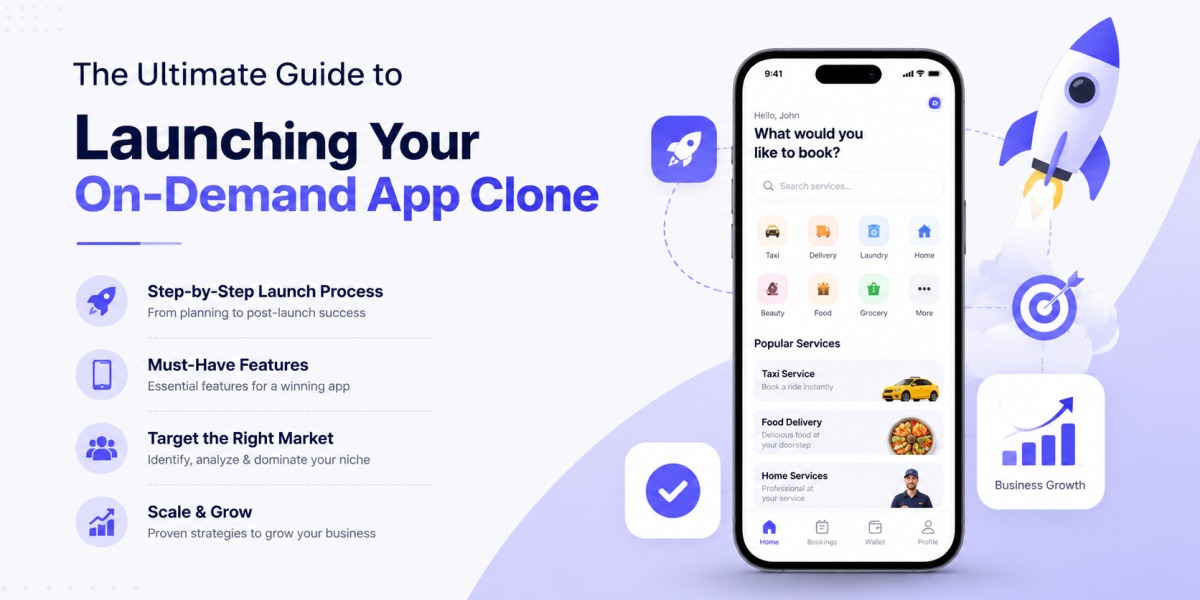
The Ultimate Guide to Launching Your On-Demand App Clone
Mobile Apps | By Bansi Patel | 27-07-2026
In today’s ultra-modern, fast-paced digital landscape, on-demand apps have revolutionized the way consumers access products and services, creating tremendous opportunities for both entrepreneurs and businesses. Creating an on-demand app clone can be an exciting task, but it requires careful planning, a clear understanding of market performance, and a strong focus on user experience.
This comprehensive guide will walk you through the essential steps to successfully launch your on-demand app clone, from analyzing the market and choosing the right technology stack to implementing effective post-launch marketing strategies. Whether you are an experienced developer or a first-time entrepreneur, this resource will equip you with the knowledge you need to turn your app idea into reality.
Understanding the On-Demand App Market
Current Trends in the On-Demand Industry
The on-demand app market is growing rapidly, fueled by consumers' increasing desire for instant access to products and services. Users want to access services with just a few taps, which has encouraged trends such as subscription models, personalized experiences, and artificial intelligence integration.
Businesses that fail to adapt to these changing expectations may struggle to compete. Understanding emerging technologies and evolving consumer preferences is therefore essential for building a successful on-demand application.
Analyzing Competitors in the Market
To make your app successful, you need to understand your competitors and their strategies. Conducting detailed competitor research can help you identify market gaps and opportunities for differentiation.
Tools such as SWOT analysis can help you evaluate competitors based on their strengths, weaknesses, opportunities, and threats. This research can help you develop a unique value proposition and avoid repeating mistakes made by existing players.
Key Features of Successful On-Demand Apps
Usable Navigation
When it comes to app navigation, simplicity is essential. If users cannot quickly find the products or services they need, they may abandon the application.
An intuitive layout, clear icons, logical menus, and simple navigation flows can significantly improve user engagement. The goal is to make every action easy to understand, from browsing services to completing an order.
Real-Time Tracking and Notifications
Real-time tracking has become an important feature in many on-demand applications. Users want to know the current status of their orders, deliveries, or service requests.
Push notifications can provide timely updates about order confirmations, delivery progress, service availability, and completion status. However, notifications should be used carefully to avoid overwhelming users with unnecessary messages.
Multiple Payment Options
Offering multiple payment methods provides users with greater flexibility during checkout. Depending on the target market, an on-demand app may support credit and debit cards, digital wallets, bank transfers, and other popular payment methods.
A simple and secure payment experience can reduce cart abandonment and make it easier for customers to complete transactions.
Ratings and Reviews System
A ratings and reviews system gives users an opportunity to share their experiences and provides valuable feedback to businesses and service providers.
Reviews can also increase transparency and help new customers make informed decisions. Maintaining a fair and reliable review system is important for building trust and credibility within the platform.
Choosing the Right Technology Stack
Front-End Technologies
The front end is the first part of your application that users interact with. Choosing the right technology can help create a visually appealing, responsive, and interactive user interface.
Frameworks and technologies such as React and Angular can be used to develop modern digital interfaces. The right choice depends on your application's requirements, target platforms, performance expectations, and development resources.
Back-End Technologies
The back end powers the core functionality of an on-demand application. It manages data processing, user authentication, business logic, APIs, transactions, and overall application performance.
Technologies such as Node.js, Ruby on Rails, and Django can be used to build scalable back-end systems. Your choice should depend on factors such as project complexity, scalability, security, development expertise, and integration requirements.
Cloud Services and Hosting Solutions
Cloud infrastructure provides the foundation required to host, operate, and scale an on-demand application. Platforms such as AWS, Google Cloud, and Microsoft Azure offer hosting, storage, database, security, and scalability solutions.
Choosing reliable cloud infrastructure can help your application handle increasing traffic and maintain performance as the number of users grows.
Designing an Intuitive User Interface
Importance of User Experience (UX)
User experience is one of the most important factors that determine whether customers continue using an application. A well-designed UX should prioritize simplicity, accessibility, performance, and visual consistency.
When users can complete tasks quickly without confusion or frustration, they are more likely to return to the application and recommend it to others.
Creating Wireframes and Prototypes
Wireframes and prototypes act as blueprints for your application. They allow product teams and developers to visualize the structure, navigation, and functionality before full development begins.
Design tools such as Figma and Sketch can be used to create wireframes and interactive prototypes. This process helps identify usability issues early and reduces the cost of making significant changes during development.
Testing and Iteration of Design
Once wireframes and prototypes are ready, they should be tested with potential users and stakeholders. Usability testing can reveal confusing navigation, unclear features, or design elements that do not meet user expectations.
Collecting feedback and continuously improving the design helps create a more user-friendly application. Even a strong initial design may require several iterations before the final product is ready.
Developing Your On-Demand App Clone
Agile Development Methodology
When developing an on-demand app clone, the Agile methodology can provide flexibility and support continuous improvement. Agile development divides the project into smaller iterations or sprints, allowing teams to build, test, and improve features progressively.
Regular meetings, continuous feedback, and iterative development help ensure that the application evolves according to real user needs and changing business requirements.
Collaboration Between Developers and Designers
Successful app development requires close collaboration between designers and developers. Designers focus on creating an intuitive user experience, while developers ensure that those designs can be implemented efficiently and reliably.
Involving both teams early in the development process can reduce communication gaps and help create an application that balances usability, visual appeal, and technical feasibility.
Quality Assurance and Testing
Quality assurance is essential for identifying bugs and performance issues before an application reaches the public. Comprehensive testing should cover different devices, operating systems, screen sizes, and user scenarios.
Functional testing, performance testing, security testing, compatibility testing, and usability testing can help ensure that the application delivers a reliable experience.
Implementing Payment and Security Solutions
Choosing Payment Gateways
Selecting the right payment gateway is an important part of developing an on-demand app clone. The chosen solution should provide a smooth checkout experience, strong security, reasonable transaction fees, and support for the payment methods preferred by your target audience.
Making payments simple and convenient can reduce friction during checkout and improve the overall customer experience.
Ensuring Data Security and Compliance
Data security is critical for any digital platform that collects personal, financial, or transaction information. Businesses should implement strong encryption, secure authentication, access controls, and appropriate security practices.
Depending on the target market and industry, the application may also need to comply with relevant data protection and payment security requirements. Building security into the application from the beginning is generally more effective than attempting to add it after launch.
Fraud Prevention Measures
Online payment fraud can create financial losses and damage customer trust. On-demand applications should implement appropriate fraud prevention measures to identify suspicious activities and protect users.
Multi-factor authentication, transaction monitoring, risk-based verification, and automated fraud detection systems can help identify unusual activity. A proactive approach to fraud prevention protects both the business and its customers.
Launch Strategies for Your App
Creating a Pre-Launch Buzz
Building awareness before launch can help generate initial interest in your application. Businesses can use social media campaigns, countdowns, teaser content, email marketing, influencer partnerships, and early-access programs to attract potential users.
A well-planned pre-launch campaign can create anticipation and encourage users to download the application when it becomes available.
Choosing the Right Launch Date and Platform
Timing can influence the performance of an application launch. Businesses should consider factors such as seasonal demand, customer behavior, industry activity, and competitor launches when selecting a release date.
Companies should also determine whether to launch on iOS, Android, or both platforms based on their target audience, budget, and business objectives.
Gathering User Feedback for Improvement
After launch, user feedback becomes a valuable source of information for improving the application. Businesses can collect feedback through in-app surveys, reviews, customer support channels, and social media.
Analyzing user feedback can help identify usability problems, missing features, and opportunities for improvement. Continuous iteration allows the application to evolve based on actual customer needs.
Post-Launch Marketing and User Engagement Techniques
Utilizing Social Media Marketing
Social media marketing can help on-demand applications build awareness and maintain engagement with their target audiences. Businesses can use informative content, visual campaigns, targeted advertising, user-generated content, and promotional offers.
Creating shareable content and encouraging customers to recommend the application can also help increase organic visibility and user acquisition.
Email Marketing Strategies
Email marketing can be used to communicate with users after the application launch. Businesses can send personalized messages about new features, special offers, product updates, and relevant services.
Segmenting users based on their behavior, interests, and preferences can make email campaigns more relevant and effective.
Encouraging User Retention and Loyalty Programs
Acquiring users is only the first step. Businesses must also encourage customers to continue using the application.
Loyalty programs, in-app rewards, referral incentives, discounts, exclusive offers, and personalized experiences can encourage repeat usage. Building strong relationships with loyal customers can improve retention and create long-term value for the business.
Launching an on-demand app clone requires more than simply replicating the features of an existing platform. Businesses must understand their target audience, identify market opportunities, create a strong user experience, and continuously improve the application based on customer feedback.
By keeping up with market trends, choosing the right technology, implementing strong security measures, and investing in effective marketing, businesses can create an on-demand application that stands out in a competitive market.
Frequently Asked Questions (FAQs)
What Is an On-Demand App Clone?
An on-demand app clone is a mobile or web application inspired by the features and business model of an existing successful on-demand service. It provides a foundation that businesses can customize with their own branding, features, workflows, and unique value propositions.
How Much Does It Cost to Launch an On-Demand App?
The cost of developing an on-demand app depends on factors such as feature complexity, technology stack, design requirements, platform coverage, integrations, security requirements, and the development team's location and expertise. A basic application may cost around $10,000, while more complex applications can cost $50,000 or significantly more depending on the scope.
How Can I Ensure My On-Demand App Stands Out From Competitors?
Create an excellent user experience, offer unique value-added features, solve specific customer pain points, and develop a strong marketing strategy. Regularly collecting user feedback and improving the application based on customer needs can also help you build a competitive advantage.
What Are the Key Features I Should Include in My On-Demand App?
Important features may include user registration and profile management, service or product discovery, search and filtering, real-time tracking, push notifications, multiple payment options, ratings and reviews, order management, customer support, and an administrative dashboard.
Depending on the type of on-demand business, you may also need vendor or service-provider profiles, location-based services, booking management, scheduling, promotional tools, loyalty programs, and analytics.

Bansi Patel
| AuthorHey there! I'm Bansi Patel, a professional app developer specializing in on-demand clone app development. With extensive expertise in creating customized, scalable solutions, I focus on delivering high-quality applications tailored to the unique needs of each client. From initial concept and UI/UX design to development, testing, and deployment, I ensure seamless app experiences that enhance user engagement and support business growth. Partner with me to turn your app idea into a reliable, user-friendly digital solution built for today's competitive market.
Recent Blogs
.jpg "Benefits of Order Tracking Apps for E-Commerce")
Benefits of Order Tracking Apps for E-Commerce
Mobile Apps | 24-09-2026
.jpg "10 Ways Salesforce SMS Improves Customer Engagement")
10 Ways Salesforce SMS Improves Customer Engagement
Salesforce | 23-09-2026
.jpg "How Full Stack Development Supports Scalable Enterprise Apps")
How Full Stack Development Supports Scalable Enterprise Apps
Mobile Apps | 22-09-2026
.jpg "Seedance 2.5 vs Higgsfield for App Launch Videos")
Seedance 2.5 vs Higgsfield for App Launch Videos
Technology | 14-09-2026