

How to Build a Web Chat App With Video Calling: Tech Stack, Architecture & Cost
Chatbots | By Siva Raman | 05-08-2026
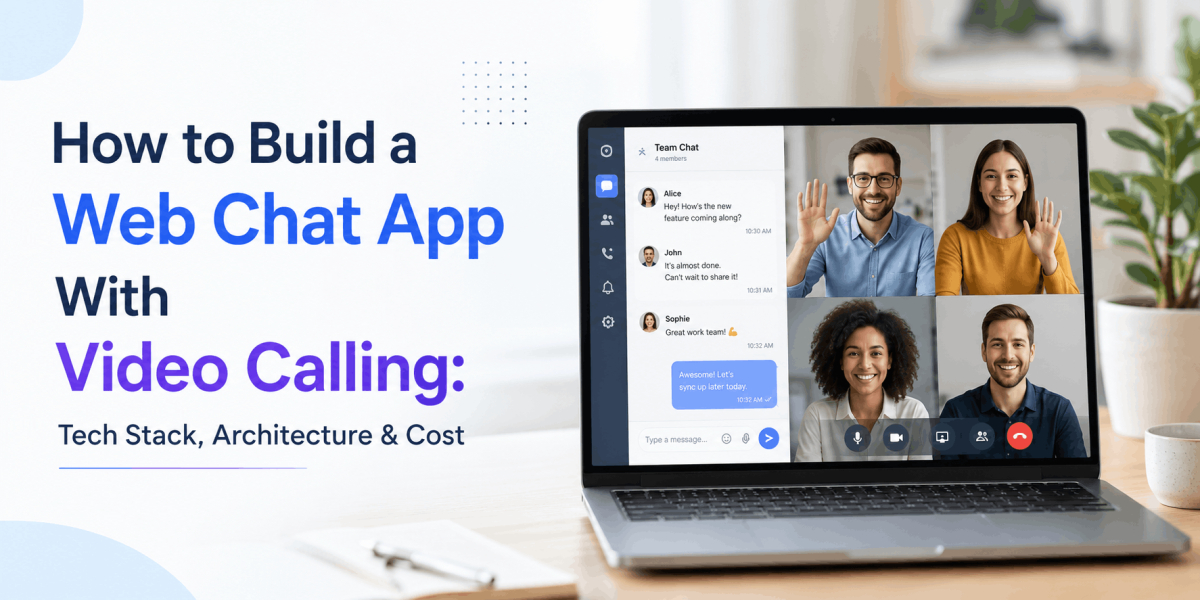
If you’re building any kind of SaaS platform, healthcare app, education tool or marketplace, the first question is "should we add chat and video calling?"
It’s not just a nice-to-have feature anymore. Users are expecting to message a support agent, video call a doctor or chat with a teammate without leaving your app/website.
So now the question really is not whether you should add real-time communication, but how do you build it, and should you build it yourself?
This article does just that. So let's talk about
- What a web chat app with video calling should look like?
- What tech stack should be used?
- How does the architecture change from a one-on-one call to group call?
- How much should it cost to build and maintain?
- Whether to build it all on-premises or use an existing chat API?
What You're Actually Building?
Before we jump into the technical specifications, stacks and servers. We first need to be clear on what a web chat app actually is.
It’s easy to say add chat like it's one feature. But you're building several interconnected systems that need to work together.
Here's what teams really need:
- One-on-one & group text messaging - Users expect to talk to people and teams and not broadcast their message into the void.
- One-on-one & group video/voice calls - For many users, typing isn't always enough; they do need to talk to someone or some expert.
- Presence indicators - These are tiny but powerful online/offline and typing signals are what make a chat app feel alive.
- Messaging history and persistence - Conversations don't disappear when someone closes their app or laptop.
- Notifications - Nobody's staring at your app 24/7 and they need a push notification when something important happens.
Now these are some things you might need to plan early before we get into the technicalities.
Note: Architecturally, group video calling is different from one-to-one calling. It's not just "the same thing done with more people."
Tech Stack for Building a Video Chat Web App
Now let’s talk about the actual building blocks. The real decisions start here when you want to build a video chat web app.
Frontend
For the frontend, most teams use React, Vue or Angular because those frameworks handle real-time state changes well when messages and call statuses are changing very often.
On top of that, you'll be capturing audio and video from the camera and microphone using the browser's native WebRTC APIs.
Note: WebRTC doesn't work on every browser and device. Safari historically lags behind Chrome and Firefox on certain WebRTC features, and mobile browsers can sometimes be finicky too. So test them in real-time.
Messaging Transport
For real time text messages, you need something more than a "refresh the page every few seconds" approach.
That is where WebSocket steps in, either via Socket.io or a native WebSocket implementation. This persistent connection makes real-time chat feel instant, without lag.
Media Transport
Video and audio travel differently than text messages do. They go through WebRTC and the quality of what your users see and hear depends on the codec you use.
Videos are processed via VP8, VP9 and H.264 while audio is processed via Opus. The codec matters more than most people realize when they build video chat web app infrastructure.
Note: Video is compressed better with VP9 and H.264 at lower bandwidth but requires more processing power from the device. So, quality is always a trade-off with performance.
Signaling Server
Before two people can actually see or hear each other, the devices must agree on how to connect. The signaling server does that in Node.js or Go.
It handles the exchange of SDP (Session Description Protocol) offers and answers. So, each device signals "this is what I support" and ICE (Interactive Connectivity Establishment) candidates. This is essential for connecting different network paths.
Media Server: SFU and MCU
Here’s where things get really interesting. This is one of the pieces of infrastructure that most teams underestimate. You have two main approaches:
- SFU (Selective Forwarding Unit) - This server forwards each participant's video stream to everyone else without mixing anything up. This consumes fewer server resources and is the default for most modern apps today.
- MCU (Multipoint Control Unit) - With this one, you combine all the incoming video streams into one combined video before sending it out. It is more compute-intensive but useful in some broadcast situations.
You can read more about how to pick one later on, but know these two names. You'll see them everywhere when you search for how to create a video chat web app.
TURN and STUN Servers
These two terms get tossed around so much without much explanation. Here’s what they are:
- STUN helps a device get its own public IP address so it can connect directly to another device.
- TURN acts as a relay when a direct connection is impossible due to a restrictive firewall or NAT setup, and routes the media traffic through it instead.
Message Infrastructure at Scale
When your app gets beyond a few users chatting on one server, you need something to distribute messages across multiple servers.
Redis Pub/Sub or Kafka usually steps in here and moves messages where they belong, even when your infrastructure scales horizontally.
Database
You need somewhere to actually store all this data, like messages, user states and chat history. They usually use either PostgreSQL or MongoDB.
Given that messages are largely unstructured, the document-based structure of MongoDB fits chat data naturally. With PostgreSQL, you need absolute relational integrity so users, channels and permissions are linked together perfectly.
Architecture Walkthrough: One-to-One vs. Group Calls
| Aspect | One-to-One Call | Group Call |
| Connection Type | Peer-to-peer (P2P) between two devices | Server-mediated via SFU or MCU |
| Signaling Process | SDP offer/answer + ICE candidate exchange between two peers | Same signaling process, but coordinated across multiple participants simultaneously |
| Connection Path | STUN attempts direct P2P connection first | All streams route through a media server |
| Fallback Mechanism | TURN relays media if direct connection fails | TURN still used for individual participant connections to the media server |
| Bandwidth Load | Fixed, one upload and one download stream per device | Multiplies with each participant in a mesh setup, which is why SFU/MCU exists |
| Server Role | Signaling server only; no media processing needed | Media server (SFU or MCU) actively forwards or mixes streams |
| SFU Behavior | Not applicable | Forwards each participant's stream to everyone else without mixing |
| MCU Behavior | Not applicable | Mixes all incoming streams into a single composite video before sending it out |
| Compute Load | Minimal server compute, mostly signaling | SFU: moderate server load; MCU: high server load due to mixing |
| Best Use Case | Direct calls, support chats, private conversations | SFU: team meetings, social calls; MCU: webinars, broadcast-style sessions |
| Realistic Participant Ceiling | Not a concern, always two participants | Mesh breaks down past 4–5 participants; SFU handles far more than MCU due to lower per-participant compute overhead |
Why Do Group Calls Need a Totally Different Approach?
With a one-to-one call, you have a simple connection between two devices. But when doing this peer-to-peer with five, six or 10 people, each device would have to send its video stream to every other device on the call.
This is called a mesh network, and it breaks down quickly. Each additional participant adds bandwidth and processing load to every device already on the call. That's why building group video chat web app needs a very different architecture:
- SFU approach - The participants each send just a single outbound stream to the server, which in turn forwards it to everyone else on the call. This makes the load on each device manageable since each device only uploads once per call.
- MCU approach - More heavy lifting is required here, as the server combines all incoming streams into one video feed and sends it back out. That means client devices do almost no processing - great for low-power devices.
So, when you need individual video feeds, SFU seems reasonable. But if you build something large like a webinar or a one-to-many where most people are watching more than participating, an MCU makes more sense because it reduces what the client has to handle.
Security and Compliance
Any kind of web video chat app that you plan on using for real conversations cannot have security bolted on at the end.
Here are a few non-negotiable ones:
- End-to-End Encryption - You should encrypt all messages so only the sender and the intended recipient can see what's being said, not even your servers should be able to see it.
- TLS Encryption - Signaling traffic will use TLS encryption so the SDP/ICE exchange you heard about earlier isn't intercepted while the call is set up.
- Compliance Focused - When you build for healthcare, finance or another regulated industry, data residency requirements are likely to apply. Some regulations demand that certain types of highly sensitive communication data be kept within certain geographic areas or on infrastructure controlled by the organization itself, rather than in some third-party cloud service. So, you’ll need a self-hosted web chat solution to stay compliant.
Cost and Timeline to Build a Chat Web App With Video Calling
Now get real about money and time because this is where a lot of teams get blindsided. You might think building a chat and video app is easy until you start pricing it out.
- TURN and media server bandwidth are probably the biggest expenses of the entire project. Those costs are tied to concurrent call minutes, not just registered users.
- Cross-browser and cross-device testing take up more time than most people budget for. WebRTC behaves differently across Chrome, Safari, Firefox and mobile browsers.
- Ongoing protocol and security maintenance is a continuous expense. WebRTC standards change, codecs are updated and security patches must be applied.
- Infrastructure scaling costs do not increase linearly with usage. TURN relay usage, SFU compute requirements and database load can grow rapidly.
Which is Better: Building In-House or Using a Chat API/SDK?
After mapping out the architecture, you decide if you want to build it all yourself or buy a premade solution.
Building In-House Web Chat App
To build in-house from scratch means owning every layer like signaling server, SFU/MCU media infrastructure, TURN server hosting, cross-platform SDKs, as well as all the maintenance to keep protocols and security up to date.
It's a long-term engineering challenge and not a one-off build. There are app development companies that do this for you, but it is very expensive.
Readymade Chat API/SDK
For a prebuilt chat API/SDK solution, companies like MirrorFly, GetStream and Sendbird have built and tested this whole stack already.
So instead of spending months standing up signaling servers and media infrastructure from scratch, teams can plug in a chat API or SDK and have real-time messaging and video calling up and running in a fraction of the time.
These providers differ mainly in their deployment model, pricing, and the level of pre-built UI included versus what you need to build yourself.
Build In-House vs. Use a Chat API/SDK
| Factor | Build In-House | Use a Chat API/SDK |
| Signaling Server | You design, host, and maintain it yourself | Fully managed by the provider |
| Media Infrastructure (SFU/MCU) | Requires setting up and scaling your own media servers | Pre-built and already optimized for scale |
| TURN/STUN Hosting | You provision and pay for relay infrastructure directly | Included as part of the provider's infrastructure |
| Cross-Platform SDKs | Must be built separately for web, iOS, and Android | Ready-made SDKs available across all platforms |
| Development Time | Several months to over a year | Just days for integration |
| Ongoing Maintenance | Your team handles updates, security patches and scaling | Provider handles infrastructure updates and security |
| Customization | Full architectural control | Customizable based on provider capabilities |
| Data Ownership & Compliance | Complete control over data | Depends on provider; some offer self-hosted deployment |
| Upfront Cost | Higher due to engineering and infrastructure | Lower through subscription/licensing |
| Long-Term Cost | Can become predictable at enterprise scale | Scales with usage |
| Best Fit | Chat/video is your core product | Chat/video is a supporting feature |
If you're looking for a self-hosted communication solution where you get complete control over your data, then you can look for MirrorFly’s Chat API & SDK. It can be deployed both on-premises or in the cloud based on your requirements.
That’s not all, it provides full source code access unlike anyone else, where you can customize permissions, features, UI/UX design and more the way you want. The incredible flexibility without the overhead headache is exactly what enterprises need to fit their compliance needs.
FAQs
1) How do you build a group video chat web app specifically, not just one-to-one for calls?
The main shift is to use SFU or MCU architecture instead of a peer-to-peer mesh network that works fine for one-on-one calls but breaks down with more participants. That makes larger group calls stable and scalable by centralizing stream forwarding or mixing through a server.
2) Is WebRTC free to use for a video chat web app?
The WebRTC protocol itself is free and open-source, where you pay no licensing fees to use it. But the actual infrastructure to run it in production, including signaling servers, TURN relays and media servers, adds hosting and bandwidth costs.
3) Is a web-based video chat app secure?
Yes, it can be, but security is not built into WebRTC by default. End-to-end encryption, TLS for signaling traffic and access controls must be implemented properly.
4) Does WebRTC work the same across all browsers?
Not quite. Most modern browsers support WebRTC, but Safari and some mobile browsers still have differences in codec support and API behavior. Cross-browser testing should be part of the development timeline.
5) Should you build a video chat web app in-house or use a ready-made API/SDK?
It depends on your business goals and budget. Pre-built solutions from platforms like MirrorFly, GetStream and CometChat provide faster implementation, self-hosted options and deep customization.
Final Thought
Making a web chat app with video calling is not as easy as picking some libraries and calling it a day. Real architectural decisions, such as SFU versus MCU for group calls and real financial trade-offs, like realizing TURN bandwidth, might end up being your biggest infrastructure cost. Both the technical approach you take and the build-versus-buy decision come down to one thing: Money.
Ask these questions before making a choice. How do you place chat and video in the context of your product priorities? Is this what makes your product unique? Is it just a necessary supporting feature that needs to work but isn't what you're building your business on?
When you get answers to these, the path becomes much clearer.
.png)
Siva Raman
| AuthorSiva is a Digital Marketing Associate at MirrorFly, where he works on SEO strategy and content optimization for chat API and real-time communication solutions.
Recent Blogs
.jpg "Benefits of Order Tracking Apps for E-Commerce")
Benefits of Order Tracking Apps for E-Commerce
Mobile Apps | 24-09-2026
.jpg "10 Ways Salesforce SMS Improves Customer Engagement")
10 Ways Salesforce SMS Improves Customer Engagement
Salesforce | 23-09-2026
.jpg "How Full Stack Development Supports Scalable Enterprise Apps")
How Full Stack Development Supports Scalable Enterprise Apps
Mobile Apps | 22-09-2026
.jpg "Seedance 2.5 vs Higgsfield for App Launch Videos")
Seedance 2.5 vs Higgsfield for App Launch Videos
Technology | 14-09-2026