
Performance Marketing in 2026: Strategies for Measurable and Predictable Growth
Digital Marketing | By Kevin Morgan | 25-06-2026
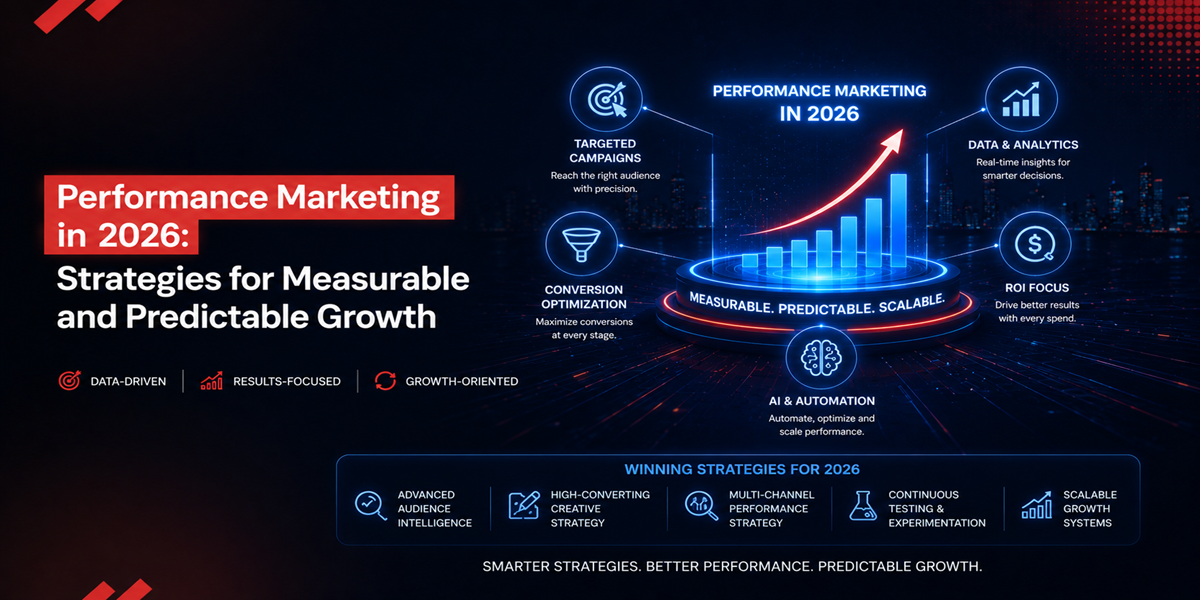
Performance Marketing in 2026 is no longer about squeezing the lowest cost per click out of a channel. It is about building a revenue system that can adapt to AI-shaped search, privacy-aware measurement, and faster buying decisions without losing control of efficiency. The strongest brands are not just spending - they align intent, creatives, landing pages, and measurement into one commercial engine. That shift is already visible in how major platforms are changing search, shopping, and campaign automation.
This blog explores the strategies, structural shifts, and emerging trends defining performance marketing in 2026, along with the frameworks businesses need from their performance marketing services to achieve measurable and predictable growth in an increasingly AI-driven market.
What Has Actually Changed?
For years, the framework was simple optimize bids, retarget aggressively and scale winning campaigns. That approach still exists - but it no longer guarantees profitable growth.
The industry has entered a new phase where predictability matters more than volume. Several major shifts are shaping the market:
AI-led search experiences are changing user behavior
Search is no longer limited to traditional keyword-result interactions. AI-generated search summaries, conversational search experiences, and predictive recommendations are reducing the visibility of low-quality content and weak landing pages. Brands now need:
- Structured information,
- Clearer messaging,
- Stronger authority signals,
- And better user experience consistency.
Performance-driven teams are increasingly optimizing for visibility inside AI-driven discovery environments rather than only optimizing just for rankings.
Automation is becoming the default operating system
Google, Meta, Amazon, LinkedIn, and TikTok are all pushing advertisers toward automated campaign systems.
Bidding, audience expansion, budget allocation, creative rotation, and campaign optimization are increasingly handled through machine learning systems instead of manual controls. The competitive advantage no longer comes from adjusting bids manually every hour.
It comes from:
- Feeding platforms better data,
- Improving creative quality,
- Strengthening conversion infrastructure,
- And refining strategic direction.
Privacy restrictions are reshaping measurement
Third-party cookies continue losing importance across the advertising ecosystem. As a result, brands are investing more heavily in:
- First-party data,
- Server-side tracking,
- Consent-aware analytics,
- CRM integration,
- And modeled attribution.
The focus has shifted from “tracking everything” to measuring what actually influences revenue.
However, the old funnel still exists, but it is weaker as a planning model. Buyers now move through a mix of search, video, social feeds, retail surfaces, and AI-generated answers before they convert.
Google has been expanding ads inside AI Overviews, rolling out AI Max for Search, and adding agentic capabilities for campaign management.
This matters because it changes the way a brand should think about performance marketing. The job is no longer to “buy traffic” and hope a landing page fixes the rest. The job is to understand intent, reduce waste, and connect every touchpoint to a real business outcome.
The 2026 Mindset: Build For Proof - Not Noise
High-growth brands in 2026 share several operational similarities. They are:
- Simplifying reporting structures,
- Prioritizing profitability over vanity metrics,
- Improving creative velocity,
- And aligning marketing decisions directly with revenue outcomes.
Most importantly, they are treating performance marketing as a business growth system instead of a paid advertising function.
This means fewer assumptions, less dependence on last-click attribution, and more discipline around what actually drives growth. Google’s Meridian, its open-source marketing mix modeling framework, is built around privacy-durable measurement and budget planning, while Google’s newer guidance and tools continue to push brands toward more causal, cross-channel decision making.
For senior teams, the practical question is simple - what gives us confidence to scale?
In 2026, the answer is usually some combination of experimentation, incrementality testing, CRM feedback, and modeled measurement. That is where a serious ROI-driven marketing strategy begins.
The Commercial Logic Behind Modern Growth
A useful framework looks like this:
- Capture demand where intent is already present.
- Shape demand where buyers are still comparing options.
- Convert demand with a strong offer and a frictionless page.
- Reinvest only when the numbers prove the channel is adding value.
1. Shift From Channel-Based Marketing to Intent-Based Marketing
The first mistake most teams make is planning media around platform preference. In 2026, that is too shallow. Search, retail, social, and video all serve different roles. A serious plan starts with intent architecture - what the buyer is trying to solve, how informed they already are, and how close they are to purchase.
A clean intent model usually has four layers:
- High intent: branded search, category search, comparison queries, shopping surfaces.
- Consideration: product education, reviews, side-by-side comparison content.
- Discovery: social video, creator content, demand generation placements.
- Retention: cross-sell, upsell, remarketing, and lifecycle campaigns.
This is also where digital advertising trends are heading and nowhere is this more evident than in performance marketing for D2C brands, where intent signals across search, social, and retail surfaces directly determine revenue efficiency.
Google’s AI Max for Search is built to broaden query coverage and improve creative matching, while Demand Gen and Performance Max are being positioned as broader discovery and conversion systems.
2. Use Automation to Scale
Automation is now a baseline - not a differentiator. The real advantage comes from how a team uses it. Google’s agentic updates are a good signal here - the platform is moving toward campaign assistance, analysis support, and workflow simplification, but it still expects brands to define the business objective, the inputs, and the guardrails.
That means the human role is changing. Teams should let automation handle:
- Bid movement,
- Budget pacing,
- Routine optimization,
- Audience expansion,
- Asset rotation,
- And reporting support.
But humans should still own:
- Offer strategy,
- Margin thresholds,
- Audience exclusions,
- Landing-page quality,
- And creative direction.
That division of resource matters. Platforms can optimize faster than any team can manually manage at scale, but they still need strong commercial inputs. Without those, automation simply amplifies weak strategy.
3. Treat Creative as a Revenue Lever
Creative quality has become one of the most important performance variables in modern advertising. Platforms are automating distribution more aggressively than ever before. That means creative is increasingly determining whether campaigns scale efficiently or collapse under rising acquisition costs.
Weak creative now fails faster. Meanwhile, strong creative compounds faster.
What does a high-performing creative look like in 2026?
The best-performing campaigns typically include:
- Short-form vertical videos,
- Founder-led storytelling,
- Customer proof content,
- Educational hooks,
- Direct-response messaging,
- And modular creative systems.
Instead of producing one polished ad every few months, brands are building continuous creative testing pipelines.
Why is modular creative outperforming static campaigns?
Modular creative allows teams to test headlines, hooks, CTAs, visuals, proof points, and offers independently. This improves optimization speed significantly.
It also aligns more effectively with AI-powered ad systems that require multiple asset combinations for better delivery optimization.
4. Optimize the Entire Conversion Journey
Conversion efficiency is becoming more valuable. That is reshaping how brands approach landing pages, checkout experiences, and funnel architecture.
Most performance problems are not traffic problems
Many campaigns fail because:
- The landing page lacks clarity,
- Trust signals are weak,
- Forms are too long,
- Messaging feels generic,
- Or the conversion path creates friction.
Even highly optimized ad campaigns struggle when post-click experiences are weak.
High-converting landing pages usually include
Clear message alignment
The landing page must immediately reflect the promise made in the ad.
Strong proof elements
Use customer outcomes, testimonials, case studies, recognizable client associations, or product credibility indicators.
Reduced friction
Simplify forms, navigation, checkout flows, and unnecessary decision points.
Fast-loading experiences
Page speed remains a major performance factor, especially on mobile-first traffic sources.
This is why conversion rate optimization is becoming deeply integrated into performance operations rather than treated as a separate UX function.
5. Build a Smarter Measurement Infrastructure
Measurement is becoming one of the biggest competitive advantages in digital growth. Many businesses still rely heavily on last-click attribution, platform-reported ROAS, or isolated campaign dashboards.
That approach creates distorted decision-making.
What does modern measurement look like?
The strongest teams now combine:
- Attribution models,
- Marketing mix modeling,
- CRM reporting,
- Incrementality testing,
- And revenue-based forecasting.
This creates a much clearer picture of what is actually driving business growth. Instead of measuring clicks, impressions, and surface-level conversions, they prioritize:
- Customer acquisition cost,
- Sales-qualified leads,
- Contribution margin,
- Retention impact,
- And revenue efficiency.
These are the marketing performance metrics leadership teams actually care about.
6. Follow Spend Where Buyer Intent Is Highest
Budget allocation should follow customer intent - not internal platform preference. The strongest performance strategies invest more heavily in channels where purchase intent is already developing or actively visible.
A balanced channel mix typically looks like this:
- Search for capturing immediate demand from users actively looking for solutions.
- Retail media for reaching shoppers closer to purchase decisions within commerce ecosystems.
- CTV and digital video for building persuasion and influencing consideration at scale.
- Social platforms for product discovery, creator influence, audience engagement, and retargeting.
- Remarketing campaigns for re-engaging undecided users and improving conversion efficiency.
One of the biggest mistakes brands make is expecting every channel to generate the same type of outcome as search advertising. Each platform serves a different role within the customer journey.
Search captures intent.
Video builds intent.
Social shapes perception and discovery.
Remarketing reduces drop-offs.
A strong media strategy recognizes these differences and assigns budgets accordingly.
7. Prioritize First-Party Data Before It Becomes Mandatory
Data quality is becoming more important than audience size. As privacy standards tighten, businesses with strong first-party data infrastructure are gaining a major strategic advantage.
What brands are investing in now?
Leading companies are strengthening:
- CRM ecosystems,
- Customer segmentation,
- Server-side tracking,
- Loyalty programs,
- Email capture systems,
- And behavioral analytics infrastructure.
This improves targeting quality, attribution accuracy, retention marketing, and predictive campaign optimization.
Why does this matter for long-term growth?
Platforms increasingly reward brands with stronger data ecosystems. Better data improves audience modeling, conversion prediction, bidding efficiency, and automated optimization accuracy.
In simple terms - better inputs now create better advertising outcomes.
8. Diversify Beyond Traditional Search and Social
Brands relying entirely on traditional search and feed-based social advertising are becoming vulnerable to rising costs and platform dependency.
Retail media is growing aggressively
Retail media networks continue attracting larger advertising budgets because they operate closer to purchasing behavior. Brands are investing more heavily into:
- Amazon Ads,
- Walmart Connect,
- Instacart Ads,
- and marketplace ecosystems.
These environments often provide stronger commercial intent signals than broader awareness platforms.
9. Make the Site Easier to Trust
Even the best media plan fails when the destination page feels weak. Buyers are faster now. They compare more. They leave sooner when trust is missing. That is why site speed, clarity, and proof all matter more than ever.
A stronger site experience should include:
- Obvious navigation,
- Concise product or service explanations,
- Clear pricing or next-step guidance where possible,
- Testimonials or proof in the right places,
- And a page hierarchy that keeps attention moving.
This is also where performance marketing services are most valuable when teams lack internal depth. The right partner will not just run campaigns. They will connect media, creative, landing-page structure, and measurement into one operating model.
AI Is Reshaping Campaign Operations Faster Than Most Brands Expected
AI is not replacing human resources. It is replacing repetitive operational work. That distinction matters. The strongest teams are using AI to:
- Accelerate reporting,
- Identify audience patterns,
- Improve campaign analysis,
- Generate creative variations,
- And speed up optimization workflows.
But strategic thinking still remains human-led.
What AI cannot replace?
AI still struggles with:
- Positioning strategy,
- Emotional nuance,
- Category differentiation,
- Customer psychology,
- And long-term brand direction.
The companies winning right now are combining machine efficiency, human strategy, and strong commercial judgment. That balance is becoming the real competitive advantage in performance marketing.
The Most Effective Channel Mix in 2026
The strongest media strategies are balancing demand capture, demand creation, and conversion efficiency. A modern allocation framework often looks like this:
| Channel | Best For |
|---|---|
| Search | High-intent demand capture, branded acquisition, bottom-funnel efficiency |
| Retail Media | Commerce-driven conversions, marketplace visibility, purchase-ready audiences |
| Social Platforms | Discovery, creator-led influence, rapid creative testing |
| Connected TV and Video | Scaled persuasion, attention-building, audience expansion |
| Remarketing | Hesitation recovery, abandoned journeys, conversion lift |
Each platform contributes differently to revenue generation.
Final Thoughts
The future of performance marketing will not belong to brands chasing every new platform trend. It will belong to organizations that build adaptive growth systems. In 2026, successful brands are:
- Combining automation with strategic oversight,
- Prioritizing commercial intent,
- Improving creative velocity,
- Strengthening first-party data ecosystems,
- And optimizing every stage of the conversion journey.
The shift is clear. Performance marketing is no longer about isolated campaigns. It is about building a scalable, measurable, and commercially resilient growth engine that continues to perform even as platforms, privacy rules, and customer behavior evolve.
Businesses that embrace this shift early will create more stable acquisition systems, stronger margins, and more predictable long-term growth through smarter performance marketing services and integrated digital strategies.

Kevin Morgan
| AuthorThis blog is published by Kevin Morgan.
Recent Blogs
.jpg "Benefits of Order Tracking Apps for E-Commerce")
Benefits of Order Tracking Apps for E-Commerce
Mobile Apps | 24-09-2026
.jpg "10 Ways Salesforce SMS Improves Customer Engagement")
10 Ways Salesforce SMS Improves Customer Engagement
Salesforce | 23-09-2026
.jpg "How Full Stack Development Supports Scalable Enterprise Apps")
How Full Stack Development Supports Scalable Enterprise Apps
Mobile Apps | 22-09-2026
.jpg "Seedance 2.5 vs Higgsfield for App Launch Videos")
Seedance 2.5 vs Higgsfield for App Launch Videos
Technology | 14-09-2026