

Transforming Access to Essential Medicines through a Pharmacy Delivery App
Mobile App Development | By Jack William | 11-11-2025
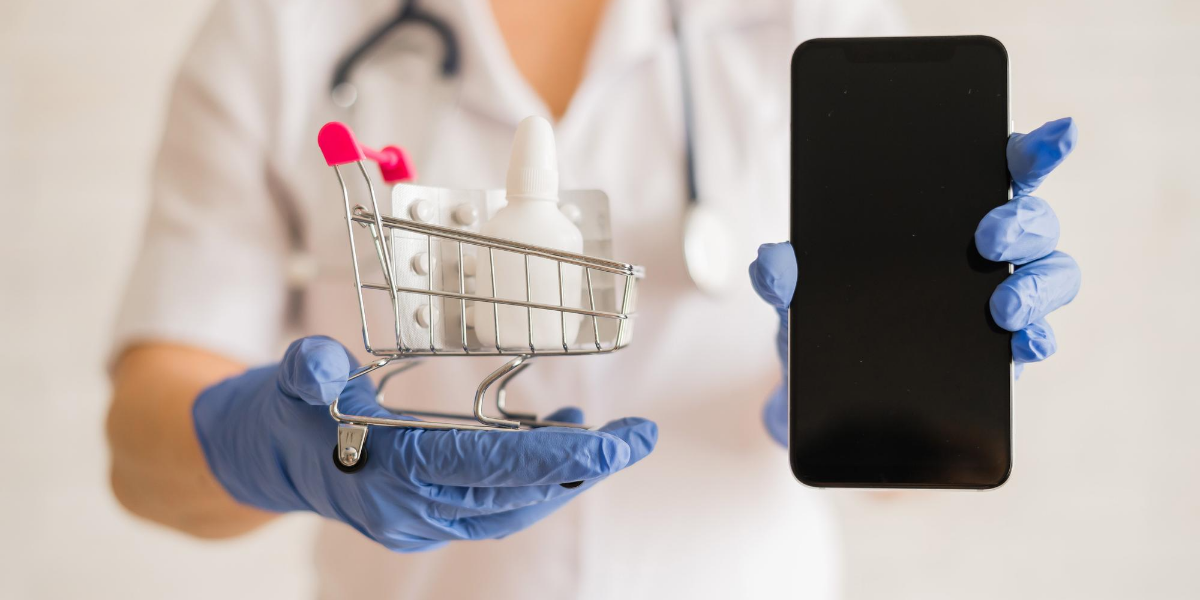
In the modern world of bustle, healthcare no longer has borders; it is no longer just a visit to the hospital or the local pharmacy. Due to the digital revolution, the way individuals seek medicines is changing rapidly. An appropriately developed pharmacy delivery application solution has the potential to revolutionize this area by providing the necessary medication at patients' convenience, breaking barriers, and enhancing health outcomes. We discuss below how such an application can revolutionize healthcare access, why it is vital in emerging markets, why it benefits both patients and pharmacies, what features make it so effective, and the issues that must be addressed to ensure its success.
Why easy access to medicines is a critical health issue today
The availability of basic medicines is a significant problem in most regions of the world. Most patients are challenged by distance to drugstores, unavailability of supplies at the nearby stores, working hours, and, physically, (particularly among the elderly or the disabled), and even by the timeliness of prescriptions. A pharmacy delivery application can significantly mitigate or eliminate these obstacles by allowing customers to order and have drugs delivered to their door from a mobile phone. One source states that medication delivery apps can enhance access and equity by enabling rural and mobility-impaired patients to obtain medications promptly.
In addition, individuals are unable to access their medicines consistently, leading to reduced compliance, which in turn translates into worse health outcomes and increased health system expenditures. A solution based on delivery can ensure the prescription is filled, refills are on time, and no one is left behind due to logistical limitations.
How a pharmacy delivery app development approach bridges the gap
Developing a specific mobile platform that links patients, pharmacies, logistics, payment systems, and regulatory checks, a pharmacy delivery app development framework can be seen as a potent facilitator of access to medicine. Here’s how it bridges the gap:
- Digital Ordering – Patients/caregivers can visit, pick, and order medicines on their smartphone on any day of the day.
- Prescription Upload & Verification – The application may give users the option to upload a prescription image (where necessary) or select OTC drugs for remote verification by a licensed pharmacist. This Wide-Area Delivery is an ingredient of many app solutions, where medicines are delivered directly to the door of the patient, which is an essential feature for those people who have to live a long distance from a real-life pharmacy. As an example, one online pharmacy application in India is applicable to more than 1,200 cities and 19,000 pin codes.
- Inventory & Supply-Chain Integration – The inventory will be managed in real-time, ensuring the app displays accurate availability, prevents out-of-stock situations, and supports efficient logistics. This is among the advantages that on-demand medicine delivery platforms have been said to have.
- Refill Reminders & Adherence Tools – The app automatically reminds the user when it is time to refill, tracks medication intake history, and thus enhances adherence. Push notifications, auto-refill, and dose alarm are listed as one of the benefits that increase adherence by up to 30%.
- Data & Analytics – The app has the potential to create data on user behavior, medicine usage patterns, refill delays, and outcomes, which can be used by the pharmacies and other health providers to intervene when signs of non-adherence are detected.
Therefore, an effective pharmacy delivery application is not only about convenience, but also the transformation of the medicine access ecosystem.
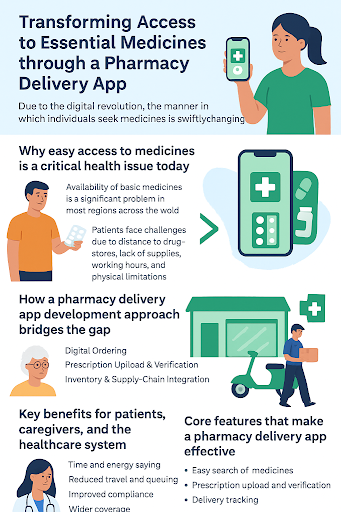
Key benefits for patients, caregiver, and the healthcare system
Implementing a pharmacy delivery app brings multiple benefits across stakeholders:
For Patients and Caregivers
- Time and energy saving convenience of ordering and delivery of medicine at home.
- Reduced travel, queuing, and delays are particularly relevant in limited mobility or remote locations.
- Improved compliance by means of automatic reminders, replacement, and scheduled deliveries, which lessen the chances of late dosing.
- Delivery discreetly (in case of sensitive drugs) and remote pharmacist assistance on questions or feedback.
- Greater Medicinal range, brand, and generic substitutes, possibly including price comparisons or discounts.
For Pharmacies, Healthcare Providers & Logistics
- Wider coverage: pharmacies can reach clients outside a local area due to the use of online ordering and delivery.
- Better inventory management and visibility in real time, reduced wastage (through expiries or unsold inventory), and reduced the number of manual mistakes.
- Increased loyalty and engagement of patients through digital touchpoints, in-app messages, deals, and value-added services.
- Cost-savings: reduced walk-in queues, reduced staffing overhead in service in-store, and decreased logistic overhead per order through route optimization.
- Enhanced supply-chain visibility, e.g, Batches, expiry date, counterfeit identification, to enhance safety and regulatory control.
For Public Health & Systems
- Enhanced medication adherence leads to fewer hospitalizations, medical complications, and the cost of the system in general.
- Equity: the rural populations or those facing mobility difficulties have access to essential medicines.
- Data insights: aggregate usage trends can inform policy, intervene, and anticipate stock-outs or supply discontinuities.
- Environmental advantages: optimized deliveries would decrease carbon footprint, in comparison to personal visits to pharmacies.
These advantages combined create an efficient argument to invest in the creation of pharmacy delivery apps.
Core features that make a pharmacy delivery app effective
In order to be successful, a medicine delivery-based platform should incorporate some basic features without which the trust, safety, or usability may be compromised. Among the must-haves are:
- Easy search of medicines (by name, brand, condition) and filters through the intuitive user interface.
- Prescription image functionality, upload and scan purpose with pharmacist verification and secure documentation.
- Live tracking of inventory and stock positions in partner pharmacies or warehouses.
- Delivery tracking: approximate time of delivery, real-time position, location of the courier, and confirmation.
- Payment integration: various payment systems (cards, wallets, UPI, and cash on delivery) are available, and payment is safe.
- Refill notifications, auto-refill, dosage notifications.
- Multi-lingual (relevant in a variety of geographies).
- Security and compliance: security of user data, secure login, authentication, and regulatory compliance (privacy, health data laws).
- Loyalty/offer modules: discounts, coupons, repeat orders.
- Customer Care: chat, call, helpdesk in app; call pharmacist consultation as required.
All these characteristics combined guarantee that the app cannot merely be an expediency tool, but a reliable, secure, and efficient platform to access medicine.
Impact on remote and underserved populations
The development of pharmacy delivery apps is one of the most radical changes in the pharmacy industry since it can be used in remote and rural or underserved areas where physical pharmacies are either scarce or unreliable. Here’s how:
- Eliminates geographic factors: This means that patients in remote areas, who are not close to the city centers or pharmacy clusters, can now have their medicines delivered at their convenience, saving time and money.
- Helps patients who need mobility: Home-bound or people in different situations who are unable to comfortably travel to a pharmacy can enjoy home delivery.
- Supplies smaller localities: Since it incorporates the logistics networks and local pharmacies, the reach is extended to smaller towns and villages.
- Delivers continuity of care: Chronic-disease patients who require periodic refills have the opportunity to be confident in the availability of digital orders and scheduled deliveries, which potentially saves the disruption of therapy.
- Fairness in medical supply: The application will alert to the presence of medicine in stock or alternatives potentially available in case patients in underserved communities have less power.
Therefore, it is important to note that the impact is not only convenience among city residents that the delivery app can contribute to a major contribution to the development of health equity.
Business model considerations and cost factors
A pharmacy delivery application does not simply include creating an interface, but it entails extensive back-end integration, logistics, regulatory compliance, and relationships. Part of the cost and business model considerations are:
- Development & Maintenance: The price of mobile application development, back-end server, API, database, analytics, security software, and maintenance.
- Although different figures may be used depending on the region and scale, most articles describing the on-demand medicine market indicate that the key aspect is maintaining the balance between cost and features.
- Medicine delivery app development cost: Although we pay key attention to functionality and advantages, the term medicine delivery app development cost appears as a keyword in numerous market analyses, with the budget planning being a key component of the project initiation.
- MVP app development: Introducing a Minimum Viable Product (MVP) with just the basic functionality and a small area of operation enables testing of the model, trial and error, and scaling. MVP app development is a very relevant term for start-ups in this industry.
- Partnerships and supply chain: Cooperation with licensed pharmacies, logistic agencies, payment platforms, and optionally, laboratories or telemedicine services.
- Logistics & fulfillment cost: Drying agents, freight software, packaging (temperature-sensitive drugs), returns.
- Regulatory compliance and licensing: The local laws that relate to pharmacy delivery, prescription, drug handling, and data privacy are complied with; these may include legal, audit, and licensing costs.
- Revenue streams: The typical options are: markup or commission on sold medicines, delivery charges, high-end delivery subscription (e.g., same-day), provider partnership, advertising/loyalty program.
- Marketing & customer acquisition: Large amounts of funds can be spent on brand creation, downloads, user and loyalty program onboarding.
With these being planned carefully, a pharmacy delivery application project would turn into an idea and a success.
Common challenges and how to overcome them
Even though the benefits of a pharmacy delivery application are numerous, some challenges should be addressed:
- Regulatory complexity: There is stricter regulation of medicines compared to most consumer goods. All these are complicated by prescription verification, drug storage, and shipping regulations. Ignoring them may cause legal risks. As observed, medicine delivery applications are in need of compliance models.
- Cold-chain / temperature-sensitive medications: There are medications that cannot be allowed to fluctuate in temperature. Such medicines must be safely dealt with through delivery mechanisms or limited.
- Inventory and stock-outs: The visibility of inventory and dependable supply is crucial in real-time, when the app displays a product, but the pharmacy cannot deliver, the levels of trust decrease.
- User trust and security: The patients must be assured of medicine authenticity, secure transactions, and medical data privacy.
- Logistics in remote areas: Supplying isolated places may make it more expensive, complicated, and time-consuming; it should be considered in the business model.
- Adoption among older users: Certain groups of patients might not be familiar with mobile apps or digital interfaces, and they might need some bridging support or alternative channels.
- Competition and price pressure: In multiple players, price wars or margin pressures may have an effect on business viability.
- Returns and pharmacy policies: The workflow should be strong to manage returns, expired medicine, cancellations, and adherence to regulations.
Some of the strategies to counter these are beginning small in geography, concentrating on trusted pharmacy partners, providing high-quality customer service and transparency, user education, investing in logistics optimization, and compliance with regulatory requirements, even at the beginning.
Real-world examples and outcomes of success
In order to demonstrate the effect, we should use some real-life examples:
- PharmEasy is a platform in India that links registered pharmacies and provides orders in 1,200+ cities and 19,000 pin codes, so that many people otherwise might not have easy access to reputed pharmacies in person.
- As an article on the most significant advantages of medicine delivery apps states, access and equity improvement, increased medication adherence, and supply-chain transparency are apparent results when these apps are implemented.
- On a business front, one of the reports found that prescription accuracy and reduction of medical waste (better inventory control and reduced expiries) can be achieved through offering pharmacy delivery services.
The above illustrations highlight that a delivery-based application, when used in an appropriate way, not only makes things convenient but also can deliver the results and cost-efficiency that can be measured.
Steps to successfully implement a pharmacy delivery app
If a pharmacy, health-tech start-up, or logistics provider is considering launching such a platform, here is a suggested high-level roadmap:
- Market research & needs assessment – know patient demographics, pharmacy density, delivery infrastructure, and regulatory environment in the targeted region.
- Define value proposition & business model – Will you rely on same-day delivery, chronic-care refills, rural outreach, premium services? Specify the sources of revenue, collaborations, and transportation expenses.
- Choose MVP features – Medicine search, prescription upload, integration with partner pharmacy, payment, delivery tracking, and refill notifications. It is here that the MVP app development mentality comes in.
- Select technology stack & partners – Choose technology stack and partners. Mobile apps (iOS/Android), backend server, database, inventory/stock inventory APIs, payment gateway, courier integration, user-auth. Compliance modules should be built.
- Pharmacy & logistics network onboarding – Find licensed pharmacies, train employees, deploy inventory feed, connect with logistics or delivery fleet.
- Regulatory & compliance framework –Make sure that there are valid licenses, data-privacy measures are established, pharmacist verification is an inbuilt feature, and that there are no local health laws being defied.
- Pilot launch – Introduce in a small geography, monitor statistics (delivery time, volume, improvement of adherence, cost per delivery, satisfaction)
- Iterate & scale – Develop UI/UX based on feedback, new functionality (loyalty, chat support, multi-language, tele-pharmacy). Grow to wider territories, optimize logistics.
- Marketing & user acquisition – Digital marketing, referral programs, collaboration with physicians/hospitals, community outreach to underserved areas.
- Continuous monitoring & improvement – Monitoring helps to monitor patterns of orders, stock-outs, delivery success rate, customer complaints, and non-adherence rates. Optimize accordingly.
With these measures, the technology, logistics, and health factors correspond to ensure a functional and scalable pharmacy delivery application.
Future outlook and innovation in pharmacy delivery apps
The digital pharmacy access is rapidly changing. The trends to consider are as follows:
- Artificial intelligence/machine learning to predict inventory stocking, customized refill alerts, dosage optimization, and health-outcome forecasting.
- Applications: Supply-chain transparency, Grants blockchain usage to enable tracking of batches of medicines, and counterfeit prevention in medicine delivery apps.
- Connected health devices connected to medicine applications, e.g., connected pill dispensers, sensor-driven reminders.
- Drones or speedy delivery logistics to remote locations or crises can shorten delivery times even more and provide access to hard-to-serve locations. The medicine delivery app has tele-pharmacy or virtual consultation built in, which is a holistic digital health platform and not an order-and-deliver service.
- Greater regulatory development and adoption of the use of digital pharmacy services, which will allow making new models more scalable and compatible with health systems.
These future trends show that the drug delivery app is not just a tool for ordering drugs but a gateway to digital healthcare, preventive care, e-patient engagement, and smarter logistics.
Conclusion
To sum it up, a well-implemented drug delivery application opens up great opportunities for improving access to essential medicines. It provides convenience and adherence for patients, expands pharmacy reach and EFFICIENCY, and strengthens public health systems by reducing gaps and increasing equity. As digital technologies advance and healthcare moves toward mobile and home, home models investing in the development of robust pharmacy delivery applications become not only strategic but imperative for organizations committed to healthcare access. And oh yeah, with careful planning, patient-centered design, and a strong logistical and compliance foundation, such apps can make a real difference to how medicines are accessed—and improve lives.

Jack William
| AuthorI am a technical content writer with over 4 years of experience in creating engaging, SEO-optimized, and user-focused technical documentation, blogs, and product content for diverse industries.
Recent Blogs
.jpg "Benefits of Order Tracking Apps for E-Commerce")
Benefits of Order Tracking Apps for E-Commerce
Mobile Apps | 24-09-2026
.jpg "10 Ways Salesforce SMS Improves Customer Engagement")
10 Ways Salesforce SMS Improves Customer Engagement
Salesforce | 23-09-2026
.jpg "How Full Stack Development Supports Scalable Enterprise Apps")
How Full Stack Development Supports Scalable Enterprise Apps
Mobile Apps | 22-09-2026
.jpg "Seedance 2.5 vs Higgsfield for App Launch Videos")
Seedance 2.5 vs Higgsfield for App Launch Videos
Technology | 14-09-2026