

The Role of Salesforce CTI in Omnichannel Customer Engagement
Salesforce | By Norah Watson | 11-09-2025
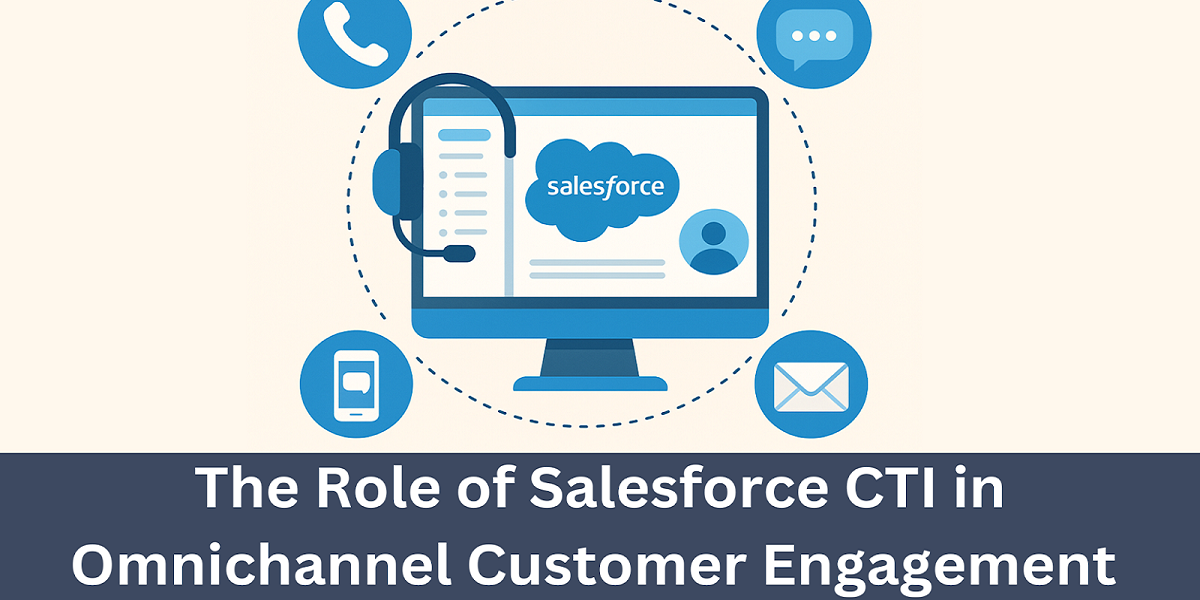
The cut throat business landscape has enabled customers to engage with brands through multiple touchpoints. This progression from one single channel to omnichannel engagement has significantly transformed the way businesses form customer experiences. Modern customers expect every interaction to be steady, personalized, and fast while predicting that organizations recognize their identity and needs at every step.
For businesses Salesforce as their CRM, the challenge extends beyond apprehending customer data. The aim is to make every engagement seamless, and outcome-driven. This is where Salesforce CTI steps in. By integrating telephony systems with Salesforce, CTI empowers teams with insights, as well as tools required to create powerful interactions that create impact.
This article brings out the role of Salesforce CTI in omnichannel customer engagement—highlighting its benefits, practical applications, and its potential in a world where customer experience is the ultimate competitive edge.
Deciphering Omnichannel Customer Engagement
Omnichannel engagement doesn’t just translate to offering various ways for customers to connect. Rather, it’s about intertwining those channels into a single, connected experience. For instance, a customer initiates a query through live chat, which is followed up by executives for more clarity. Finally, the resolution is confirmed via an email.
When these touchpoints feel repetitive, it mounts to frustration. But when interaction happens seamlessly, customers feel recognized and valued. This happens as agents are already aware of past conversations and actions. However, attaining this demands intelligence and integration rather than just channel availability. This is where Salesforce CTI plays a critical role, confirming voice interactions aren’t out-of-the-way but form a part of a unified strategy.
Comprehending the Features of Salesforce CTI
Salesforce CTI is a system that connects the telephony system of an organization with Salesforce CRM. Rather than considering phone calls as disengaged interactions, CTI implants them within the Salesforce interface. Some of its core capabilities include:
Click-to-Call: Place calls from Salesforce records.
- Screen Pop-ups: Show customer details, as soon as a call comes in.
- Automatic Call Logging: Capture calls as activities with notes and outcomes.
- Call Routing & IVR: Direct calls to the right agent who can handle the right request.
- Analytics: Provide managers with insights into resolution rates, call volume, and agent performance.
How Does Salesforce CTI Contribute to Omnichannel Engagement?
Bridging Voice with Digital Channels: When it comes to customer engagement, voice continues to be a crucial channel especially while handling complex issues. A Salesforce integrated CTI App ensures seamless connection of CTI App with other channels. With CTI, reps can access prior customer data listed within Salesforce. This unified view enables agents to retort with context, empathy and eccentricity without requiring customers to reiterate their concerns.
- Enabling Real-Time Interactions: As soon as a customer calls, agents get access to rich customer details such as purchase history, preferences and more. With such level of intelligence, agents can focus on quick resolution of issues while delivering meaningful solutions.
- Enabling Personalized Customer Journeys: By transforming phone calls into valuable interactions, Salesforce CTI transforms overall customer journeys. A single call can spur tailored actions, SMS reminders and more. CTI confirms seamless personalization across every point of contact.
- Smart Routing: Omnichannel engagement isn’t just about being there. Rather, it’s about being efficient. CTI works in association with Salesforce’s workflow tool and case routing to ensure every incoming call is directed to the right agent, based on case priority, skills or current relationships. This smart routing decreases wait times and ensures seamless and effective customer interactions.
- Continuous Enhancement with Data: Every phone call is logged in Salesforce by default. This eliminates manual effort and enriches CRM data. These insights offer businesses a clear view of call trends, repeated issues, and customer needs. Organizations can leverage this acumen to augment service strategies, boost agent performance, and fortify omnichannel campaigns.
Why Should Businesses Avail Salesforce CTI?
- Seamless Agent Experience: Agents do not have to juggle between Salesforce and telephony platforms. Rather, they operate within a single interface combines telephony controls with client data. Such an updated environment reduces disruptions, boosts productivity and promotes consistency across every channel.
- Enhanced Customer Satisfaction: CTI allows agents to deliver personalized and context-rich communications. Customers usually get infuriated especially when they have to repeat themselves while toggling between platforms. They must be valued and understood, which ultimately leads to trust and loyalty.
- Higher First-Call Resolution: CTI empowers agents to resolve issues in the first go by providing them with access to case and customer details. This not just reduces costs but also fortifies customer loyalty. Stronger Cross-Team Collaboration: CTI generates valuable insights, which could be leveraged by various teams alike. For instance, a sales rep has visibility into a customer’s recent interaction with a support staff or a marketing team can get access to call data to modify campaigns. Such type of shared visibility paves the way cross-functional alignment besides an omnichannel experience.
- Actionable Analytics: With CTI, it’s possible for businesses to track key performance indicators such as call abandonment rates, customer sentiment and more. These insights enable informed decision making.
What Does the Future Hold for Salesforce CTI in Omnichannel Engagement?
Given the rising customer expectations, Salesforce CTI is expected to evolve into a smart and adaptive solution.
- AI-Powered Call Insights: Sentiment analysis will provide agents with on-call prompts, augmenting empathy and precision.
- Voice + Digital Hybrids: Customers will be able to start with a voice bot and shift to SMS or WhatsApp without losing conversation context.
- Predictive Engagement: Leveraging past data, CTI will predict customer needs and initiate outreach before problems surface.
- Advanced AI Integration: Platforms like Einstein GPT will automatically generate call summaries, recommend next-best actions, and provide smarter coaching for agents.
Final Words:
In today’s business landscape, every discourse shapes the customer experience. While there has been a steep rise in digital channels, voice continues to be a critical point of contact in the customer journey. The challenge lies integrating voice into the ecosystem rather than keeping it siloed. CTI for Salesforce addresses this need by integrating telephony with the intelligence of CRM. It equips reps with real-time context, nurtures interactions, and produces smart insights for ongoing optimization.

Norah Watson
| AuthorThis blog is publiahed by Norah Watson.
Recent Blogs
.jpg "Benefits of Order Tracking Apps for E-Commerce")
Benefits of Order Tracking Apps for E-Commerce
Mobile Apps | 24-09-2026
.jpg "10 Ways Salesforce SMS Improves Customer Engagement")
10 Ways Salesforce SMS Improves Customer Engagement
Salesforce | 23-09-2026
.jpg "How Full Stack Development Supports Scalable Enterprise Apps")
How Full Stack Development Supports Scalable Enterprise Apps
Mobile Apps | 22-09-2026
.jpg "Seedance 2.5 vs Higgsfield for App Launch Videos")
Seedance 2.5 vs Higgsfield for App Launch Videos
Technology | 14-09-2026